Respiration in Plants — Class 11 CBSE Biology revision notes
A 4-page visual revision sheet for Respiration in Plants, written for Class 11 CBSE Biology. Formulas, diagrams and the traps that cost marks, laid out to be read the night before rather than the term before. Free, and it opens inside CapCompass.
 Page 1 as PDF
Respiration in Plants in one look
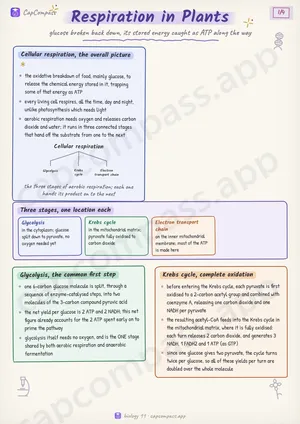
glucose broken back down, its stored energy caught as ATP along the way
Cellular respiration, the overall picture
- the oxidative breakdown of food, mainly glucose, to release the chemical energy stored in it, trapping some of that energy as ATP
- every living cell respires, all the time, day and night, unlike photosynthesis which needs light
- aerobic respiration needs oxygen and releases carbon dioxide and water; it runs in three connected stages that hand off the substrate from one to the next
Three stages, one location each
- Glycolysis: in the cytoplasm; glucose split down to pyruvate, no oxygen needed yet
- Krebs cycle: in the mitochondrial matrix; pyruvate fully oxidised to carbon dioxide
- Electron transport chain: on the inner mitochondrial membrane; most of the ATP is made here
Glycolysis, the common first step
- one 6-carbon glucose molecule is split, through a sequence of enzyme-catalysed steps, into two molecules of the 3-carbon compound pyruvic acid
- the net yield per glucose is 2 ATP and 2 NADH; this net figure already accounts for the 2 ATP spent early on to prime the pathway
- glycolysis itself needs no oxygen, and is the ONE stage shared by both aerobic respiration and anaerobic fermentation
Krebs cycle, complete oxidation
- before entering the Krebs cycle, each pyruvate is first oxidised to a 2-carbon acetyl group and combined with coenzyme A, releasing one carbon dioxide and one NADH per pyruvate
- the resulting acetyl-CoA feeds into the Krebs cycle in the mitochondrial matrix, where it is fully oxidised: each turn releases 2 carbon dioxide, and generates 3 NADH, 1 FADH2 and 1 ATP (as GTP)
- since one glucose gives two pyruvate, the cycle turns twice per glucose, so all of these yields per turn are doubled over the whole molecule
Page 1 of 4. The full sheet, all 4 pages, opens free in the app.
What this Respiration in Plants sheet covers
- Cellular respiration, the overall picture
- Three stages, one location each
- Glycolysis
- Krebs cycle
- Electron transport chain
- Glycolysis, the common first step
- Krebs cycle, complete oxidation
- Electron transport chain and oxidative phosphorylation
- Net ATP yield from one glucose
- Fermentation, respiration without oxygen
- Respiratory quotient (RQ)
- Aerobic respiration or fermentation
- Traps that cost marks
- Tricks that save time
How CapCompass uses this sheet
These notes are not a standalone PDF. CapCompass plans Biology chapter by chapter against your real exam dates and free hours, and when the plan reaches Respiration in Plants the sheet opens inside the study block itself — at the page covering the sub-topic that block is on, with the timer still running. Revision arrives at the moment the plan says revise, instead of having to be gone looking for.
More Biology Class 11 revision notes
- Anatomy of Flowering Plants
- Animal Kingdom
- Biological Classification
- Biomolecules
- Body Fluids and Circulation
- Breathing and Exchange of Gases
- Cell Cycle and Cell Division
- Cell: The Unit of Life
- Chemical Coordination and Integration
- Excretory Products and their Elimination
- Locomotion and Movement
- Morphology of Flowering Plants
- Neural Control and Coordination
- Photosynthesis in Higher Plants
- Plant Growth and Development
- Plant Kingdom
- Structural Organisation in Animals
- The Living World