Cell: The Unit of Life — Class 11 CBSE Biology revision notes
A 4-page visual revision sheet for Cell: The Unit of Life, written for Class 11 CBSE Biology. Formulas, diagrams and the traps that cost marks, laid out to be read the night before rather than the term before. Free, and it opens inside CapCompass.
 Page 1 as PDF
Cell: The Unit of Life in one look
one boundary, one nucleus or none, and everything else inside
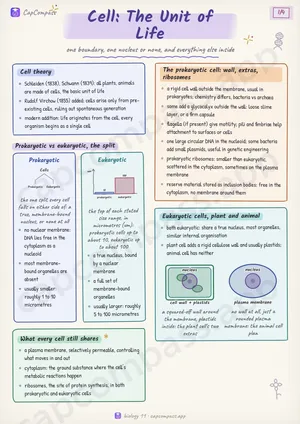
Cell theory
- Schleiden (1838), Schwann (1839): all plants, animals are made of cells, the basic unit of life
- Rudolf Virchow (1855) added: cells arise only from pre-existing cells, ruling out spontaneous generation
- modern addition: life originates from the cell, every organism begins as a single cell
Prokaryotic vs eukaryotic, the split
- no nuclear membrane: DNA lies free in the cytoplasm as a nucleoid
- most membrane-bound organelles are absent
- usually smaller: roughly 1 to 10 micrometres
- a true nucleus, bound by a nuclear membrane
- a full set of membrane-bound organelles
- usually larger: roughly 5 to 100 micrometres
What every cell still shares
- a plasma membrane, selectively permeable, controlling what moves in and out
- cytoplasm: the ground substance where the cell's metabolic reactions happen
- ribosomes, the site of protein synthesis, in both prokaryotic and eukaryotic cells
The prokaryotic cell: wall, extras, ribosomes
- a rigid cell wall outside the membrane, usual in prokaryotes; chemistry differs, bacteria vs archaea
- some add a glycocalyx outside the wall: loose slime layer, or a firm capsule
- flagella (if present) give motility; pili and fimbriae help attachment to surfaces or cells
- one large circular DNA in the nucleoid; some bacteria add small plasmids, useful in genetic engineering
- prokaryotic ribosomes: smaller than eukaryotic, scattered in the cytoplasm, sometimes on the plasma membrane
- reserve material stored as inclusion bodies: free in the cytoplasm, no membrane around them
Eukaryotic cells, plant and animal
- both eukaryotic: share a true nucleus, most organelles, similar internal organisation
- plant cell adds a rigid cellulose wall and usually plastids; animal cell has neither
Page 1 of 4. The full sheet, all 4 pages, opens free in the app.
What this Cell: The Unit of Life sheet covers
- Cell theory
- Prokaryotic vs eukaryotic, the split
- Prokaryotic
- Eukaryotic
- What every cell still shares
- The prokaryotic cell: wall, extras, ribosomes
- Eukaryotic cells, plant and animal
- The plasma membrane and cell wall
- The endomembrane system
- Organelles outside the endomembrane system
- Mitochondrion
- Plastid
- The nucleus
- The cytoskeleton and centrioles
- Cilia vs flagella
- Cilia
- Flagella
- Symbols
- Traps that cost marks
- Tricks that save time
How CapCompass uses this sheet
These notes are not a standalone PDF. CapCompass plans Biology chapter by chapter against your real exam dates and free hours, and when the plan reaches Cell: The Unit of Life the sheet opens inside the study block itself — at the page covering the sub-topic that block is on, with the timer still running. Revision arrives at the moment the plan says revise, instead of having to be gone looking for.
More Biology Class 11 revision notes
- Anatomy of Flowering Plants
- Animal Kingdom
- Biological Classification
- Biomolecules
- Body Fluids and Circulation
- Breathing and Exchange of Gases
- Cell Cycle and Cell Division
- Chemical Coordination and Integration
- Excretory Products and their Elimination
- Locomotion and Movement
- Morphology of Flowering Plants
- Neural Control and Coordination
- Photosynthesis in Higher Plants
- Plant Growth and Development
- Plant Kingdom
- Respiration in Plants
- Structural Organisation in Animals
- The Living World