Body Fluids and Circulation — Class 11 CBSE Biology revision notes
A 4-page visual revision sheet for Body Fluids and Circulation, written for Class 11 CBSE Biology. Formulas, diagrams and the traps that cost marks, laid out to be read the night before rather than the term before. Free, and it opens inside CapCompass.
 Page 1 as PDF
Body Fluids and Circulation in one look
blood, lymph and a pump that cycles both, one loop for the lungs and one for the body
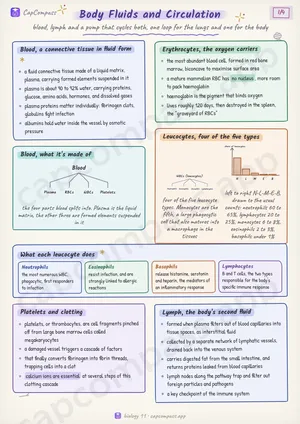
Blood, a connective tissue in fluid form
- a fluid connective tissue made of a liquid matrix, plasma, carrying formed elements suspended in it
- plasma is about 90 to 92% water, carrying proteins, glucose, amino acids, hormones, and dissolved gases
- plasma proteins matter individually: fibrinogen clots, globulins fight infection
- albumins hold water inside the vessel by osmotic pressure
Erythrocytes, the oxygen carriers
- the most abundant blood cell, formed in red bone marrow, biconcave to maximise surface area
- a mature mammalian RBC has no nucleus, more room to pack haemoglobin
- haemoglobin is the pigment that binds oxygen
- lives roughly 120 days, then destroyed in the spleen, the "graveyard of RBCs"
What each leucocyte does
- Neutrophils: the most numerous WBC, phagocytic, first responders to infection
- Eosinophils: resist infection, and are strongly linked to allergic reactions
- Basophils: release histamine, serotonin and heparin, the mediators of an inflammatory response
- Lymphocytes: B and T cells, the two types responsible for the body's specific immune response
Platelets and clotting
- platelets, or thrombocytes, are cell fragments pinched off from large bone marrow cells called megakaryocytes
- a damaged vessel triggers a cascade of factors
- that finally converts fibrinogen into fibrin threads, trapping cells into a clot
- calcium ions are essential at several steps of this clotting cascade
Lymph, the body's second fluid
- formed when plasma filters out of blood capillaries into tissue spaces, as interstitial fluid
- collected by a separate network of lymphatic vessels, drained back into the venous system
- carries digested fat from the small intestine, and returns proteins leaked from blood capillaries
- lymph nodes along the pathway trap and filter out foreign particles and pathogens
- a key checkpoint of the immune system
Page 1 of 4. The full sheet, all 4 pages, opens free in the app.
What this Body Fluids and Circulation sheet covers
- Blood, a connective tissue in fluid form
- Blood, what it's made of
- Erythrocytes, the oxygen carriers
- Leucocytes, four of the five types
- What each leucocyte does
- Neutrophils
- Eosinophils
- Basophils
- Lymphocytes
- Platelets and clotting
- Lymph, the body's second fluid
- Blood vs Lymph
- Blood
- Lymph
- Blood vessels, three kinds
- The human heart, a double pump
- Double circulation, two separate loops
- The cardiac cycle and its own pacemaker
- Blood pressure, three named ranges
- Disorders of circulation
- Hypertension
- Coronary artery disease
- Angina pectoris
- Heart failure
- Traps that cost marks
- Tricks that save time
How CapCompass uses this sheet
These notes are not a standalone PDF. CapCompass plans Biology chapter by chapter against your real exam dates and free hours, and when the plan reaches Body Fluids and Circulation the sheet opens inside the study block itself — at the page covering the sub-topic that block is on, with the timer still running. Revision arrives at the moment the plan says revise, instead of having to be gone looking for.
More Biology Class 11 revision notes
- Anatomy of Flowering Plants
- Animal Kingdom
- Biological Classification
- Biomolecules
- Breathing and Exchange of Gases
- Cell Cycle and Cell Division
- Cell: The Unit of Life
- Chemical Coordination and Integration
- Excretory Products and their Elimination
- Locomotion and Movement
- Morphology of Flowering Plants
- Neural Control and Coordination
- Photosynthesis in Higher Plants
- Plant Growth and Development
- Plant Kingdom
- Respiration in Plants
- Structural Organisation in Animals
- The Living World