Breathing and Exchange of Gases — Class 11 CBSE Biology revision notes
A 3-page visual revision sheet for Breathing and Exchange of Gases, written for Class 11 CBSE Biology. Formulas, diagrams and the traps that cost marks, laid out to be read the night before rather than the term before. Free, and it opens inside CapCompass.
 Page 1 as PDF
Breathing and Exchange of Gases in one look
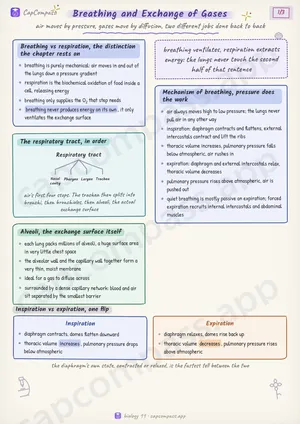
air moves by pressure, gases move by diffusion, two different jobs done back to back
Breathing vs respiration, the distinction the chapter rests on
- breathing is purely mechanical: air moves in and out of the lungs down a pressure gradient
- respiration is the biochemical oxidation of food inside a cell, releasing energy
- breathing only supplies the O2 that step needs
- breathing never produces energy on its own, it only ventilates the exchange surface
Alveoli, the exchange surface itself
- each lung packs millions of alveoli, a huge surface area in very little chest space
- the alveolar wall and the capillary wall together form a very thin, moist membrane
- ideal for a gas to diffuse across
- surrounded by a dense capillary network: blood and air sit separated by the smallest barrier
Mechanism of breathing, pressure does the work
- air always moves high to low pressure; the lungs never pull air in any other way
- inspiration: diaphragm contracts and flattens, external intercostals contract and lift the ribs
- thoracic volume increases, pulmonary pressure falls below atmospheric, air rushes in
- expiration: diaphragm and external intercostals relax, thoracic volume decreases
- pulmonary pressure rises above atmospheric, air is pushed out
- quiet breathing is mostly passive on expiration; forced expiration recruits internal intercostals and abdominal muscles
Inspiration vs expiration, one flip
- diaphragm contracts, domes flatten downward
- thoracic volume increases, pulmonary pressure drops below atmospheric
- diaphragm relaxes, domes rise back up
- thoracic volume decreases, pulmonary pressure rises above atmospheric
Page 1 of 3. The full sheet, all 3 pages, opens free in the app.
What this Breathing and Exchange of Gases sheet covers
- Breathing vs respiration, the distinction the chapter rests on
- The respiratory tract, in order
- Alveoli, the exchange surface itself
- Mechanism of breathing, pressure does the work
- Inspiration vs expiration, one flip
- Inspiration
- Expiration
- A quiet inspiration, volume against time
- Respiratory volumes, the numbers a spirometer reads
- Capacities, each one built by adding volumes
- vital capacity, VC
- total lung capacity, TLC
- inspiratory capacity, IC
- functional residual capacity, FRC
- Reading a spirometer trace
- Exchange of gases, simple diffusion down a gradient
- Three ways CO2 travels in blood
- Transport of oxygen
- Regulation of breathing
- Respiratory disorders
- Each disorder, one line
- Asthma
- Emphysema
- Occupational disorders
- Traps that cost marks
- Tricks that save time
How CapCompass uses this sheet
These notes are not a standalone PDF. CapCompass plans Biology chapter by chapter against your real exam dates and free hours, and when the plan reaches Breathing and Exchange of Gases the sheet opens inside the study block itself — at the page covering the sub-topic that block is on, with the timer still running. Revision arrives at the moment the plan says revise, instead of having to be gone looking for.
More Biology Class 11 revision notes
- Anatomy of Flowering Plants
- Animal Kingdom
- Biological Classification
- Biomolecules
- Body Fluids and Circulation
- Cell Cycle and Cell Division
- Cell: The Unit of Life
- Chemical Coordination and Integration
- Excretory Products and their Elimination
- Locomotion and Movement
- Morphology of Flowering Plants
- Neural Control and Coordination
- Photosynthesis in Higher Plants
- Plant Growth and Development
- Plant Kingdom
- Respiration in Plants
- Structural Organisation in Animals
- The Living World