Structural Organisation in Animals — Class 11 CBSE Biology revision notes
A 3-page visual revision sheet for Structural Organisation in Animals, written for Class 11 CBSE Biology. Formulas, diagrams and the traps that cost marks, laid out to be read the night before rather than the term before. Free, and it opens inside CapCompass.
 Page 1 as PDF
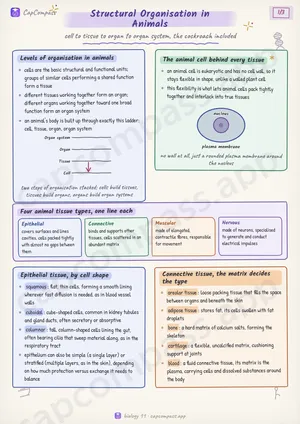
Structural Organisation in Animals in one look
cell to tissue to organ to organ system, the cockroach included
Levels of organisation in animals
- cells are the basic structural and functional units; groups of similar cells performing a shared function form a tissue
- different tissues working together form an organ; different organs working together toward one broad function form an organ system
- an animal's body is built up through exactly this ladder: cell, tissue, organ, organ system
The animal cell behind every tissue
- an animal cell is eukaryotic and has no cell wall, so it stays flexible in shape, unlike a walled plant cell
- this flexibility is what lets animal cells pack tightly together and interlock into true tissues
Four animal tissue types, one line each
- Epithelial: covers surfaces and lines cavities, cells packed tightly with almost no gaps between them
- Connective: binds and supports other tissues, cells scattered in an abundant matrix
- Muscular: made of elongated, contractile fibres, responsible for movement
- Nervous: made of neurons, specialised to generate and conduct electrical impulses
Epithelial tissue, by cell shape
- squamous: flat, thin cells, forming a smooth lining wherever fast diffusion is needed, as in blood vessel walls
- cuboidal: cube-shaped cells, common in kidney tubules and gland ducts, often secretory or absorptive
- columnar: tall, column-shaped cells lining the gut, often bearing cilia that sweep material along, as in the respiratory tract
- epithelium can also be simple (a single layer) or stratified (multiple layers, as in the skin), depending on how much protection versus exchange it needs to balance
Connective tissue, the matrix decides the type
- areolar tissue: loose packing tissue that fills the space between organs and beneath the skin
- adipose tissue: stores fat, its cells swollen with fat droplets
- bone: a hard matrix of calcium salts, forming the skeleton
- cartilage: a flexible, uncalcified matrix, cushioning support at joints
- blood: a fluid connective tissue, its matrix is the plasma, carrying cells and dissolved substances around the body
Page 1 of 3. The full sheet, all 3 pages, opens free in the app.
What this Structural Organisation in Animals sheet covers
- Levels of organisation in animals
- The animal cell behind every tissue
- Four animal tissue types, one line each
- Epithelial
- Connective
- Muscular
- Nervous
- Epithelial tissue, by cell shape
- Connective tissue, the matrix decides the type
- Bone vs Cartilage
- Bone
- Cartilage
- Muscular tissue, three types
- Nervous tissue
- Animal tissues, all four together
- Cockroach, the organ-system example
- Symbols
- Traps that cost marks
- Tricks that save time
How CapCompass uses this sheet
These notes are not a standalone PDF. CapCompass plans Biology chapter by chapter against your real exam dates and free hours, and when the plan reaches Structural Organisation in Animals the sheet opens inside the study block itself — at the page covering the sub-topic that block is on, with the timer still running. Revision arrives at the moment the plan says revise, instead of having to be gone looking for.
More Biology Class 11 revision notes
- Anatomy of Flowering Plants
- Animal Kingdom
- Biological Classification
- Biomolecules
- Body Fluids and Circulation
- Breathing and Exchange of Gases
- Cell Cycle and Cell Division
- Cell: The Unit of Life
- Chemical Coordination and Integration
- Excretory Products and their Elimination
- Locomotion and Movement
- Morphology of Flowering Plants
- Neural Control and Coordination
- Photosynthesis in Higher Plants
- Plant Growth and Development
- Plant Kingdom
- Respiration in Plants
- The Living World