Chemical Bonding and Molecular Structure — Class 11 CBSE Chemistry revision notes
A 6-page visual revision sheet for Chemical Bonding and Molecular Structure, written for Class 11 CBSE Chemistry. Formulas, diagrams and the traps that cost marks, laid out to be read the night before rather than the term before. Free, and it opens inside CapCompass.
 Page 1 as PDF
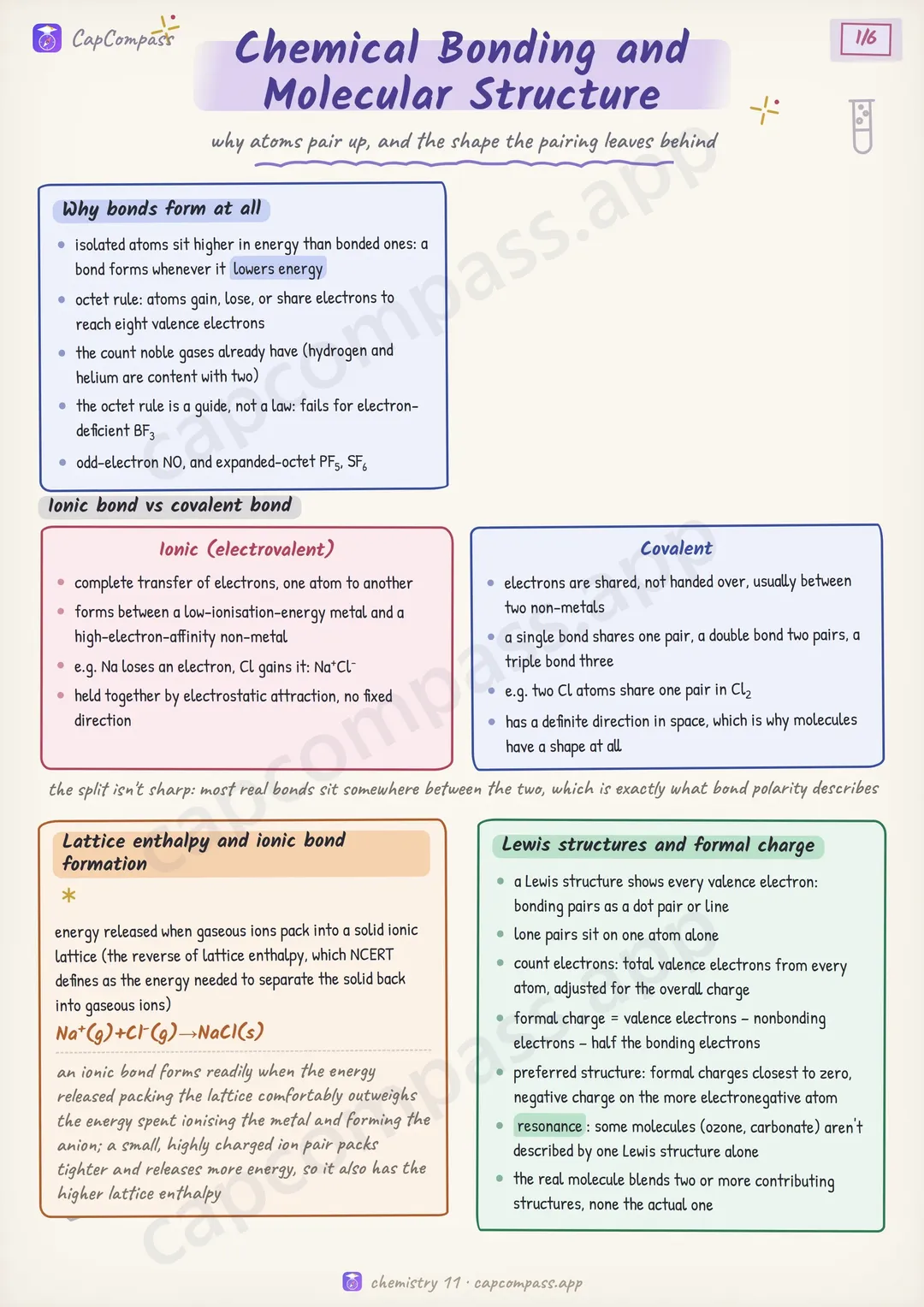
Chemical Bonding and Molecular Structure in one look
why atoms pair up, and the shape the pairing leaves behind
Why bonds form at all
- isolated atoms sit higher in energy than bonded ones: a bond forms whenever it lowers energy
- octet rule: atoms gain, lose, or share electrons to reach eight valence electrons
- the count noble gases already have (hydrogen and helium are content with two)
- the octet rule is a guide, not a law: fails for electron-deficient BF_3
- odd-electron NO, and expanded-octet PF_5, SF_6
Ionic bond vs covalent bond
- complete transfer of electrons, one atom to another
- forms between a low-ionisation-energy metal and a high-electron-affinity non-metal
- e.g. Na loses an electron, Cl gains it: Na^+Cl^-
- held together by electrostatic attraction, no fixed direction
- electrons are shared, not handed over, usually between two non-metals
- a single bond shares one pair, a double bond two pairs, a triple bond three
- e.g. two Cl atoms share one pair in Cl_2
- has a definite direction in space, which is why molecules have a shape at all
Lattice enthalpy and ionic bond formation
- energy released when gaseous ions pack into a solid ionic lattice (the reverse of lattice enthalpy, which NCERT defines as the energy needed to separate the solid back into gaseous ions)
Na^+(g)+Cl^-(g)→ NaCl(s)
Lewis structures and formal charge
- a Lewis structure shows every valence electron: bonding pairs as a dot pair or line
- lone pairs sit on one atom alone
- count electrons: total valence electrons from every atom, adjusted for the overall charge
- formal charge = valence electrons − nonbonding electrons − half the bonding electrons
- preferred structure: formal charges closest to zero, negative charge on the more electronegative atom
- resonance: some molecules (ozone, carbonate) aren't described by one Lewis structure alone
- the real molecule blends two or more contributing structures, none the actual one
Page 1 of 6. The full sheet, all 6 pages, opens free in the app.
What this Chemical Bonding and Molecular Structure sheet covers
- Why bonds form at all
- Ionic bond vs covalent bond
- Ionic (electrovalent)
- Covalent
- Lattice enthalpy and ionic bond formation
- energy released when gaseous ions pack into a solid ionic lattice (the reverse of lattice enthalpy, which NCERT defines as the energy needed to separate the solid back into gaseous ions)
- Lewis structures and formal charge
- Bond parameters
- bond length: distance between the two nuclei at equilibrium
- bond angle: angle between two bonds at a common atom
- bond order (Lewis picture): number of shared electron pairs between two atoms
- Polarity of a covalent bond
- VSEPR: predicting shape from repulsion
- VSEPR shapes by electron domain count
- Valence bond theory: overlap makes a bond
- Hybridisation: orbitals reshaped for bonding
- Reading hybridisation off a formula
- sp
- sp2
- sp3
- Worked: shape and hybridisation of NH3
- Molecular orbital theory, in brief
- Bond order from MO theory
- bond order formula
- N_2: 10 bonding, 4 antibonding electrons
- O_2: 10 bonding, 6 antibonding electrons
- O2's paramagnetism: the one thing VBT could not explain
- Hydrogen bonding
- Traps that cost marks
- Tricks that save time
How CapCompass uses this sheet
These notes are not a standalone PDF. CapCompass plans Chemistry chapter by chapter against your real exam dates and free hours, and when the plan reaches Chemical Bonding and Molecular Structure the sheet opens inside the study block itself — at the page covering the sub-topic that block is on, with the timer still running. Revision arrives at the moment the plan says revise, instead of having to be gone looking for.