Some Basic Concepts of Chemistry — Class 11 CBSE Chemistry revision notes
A 4-page visual revision sheet for Some Basic Concepts of Chemistry, written for Class 11 CBSE Chemistry. Formulas, diagrams and the traps that cost marks, laid out to be read the night before rather than the term before. Free, and it opens inside CapCompass.
 Page 1 as PDF
Some Basic Concepts of Chemistry in one look
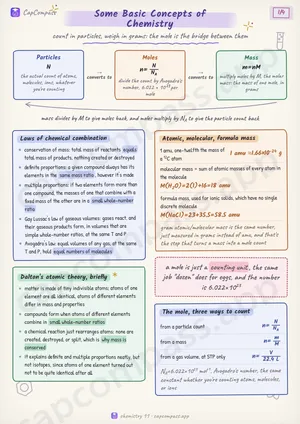
count in particles, weigh in grams: the mole is the bridge between them
- Particles: the actual count of atoms, molecules, ions, whatever you're counting
- Moles: divide the count by Avogadro's number, 6.022 × 10²³ per mole
- Mass: multiply moles by M, the molar mass: the mass of one mole, in grams
Laws of chemical combination
- conservation of mass: total mass of reactants equals total mass of products, nothing created or destroyed
- definite proportions: a given compound always has its elements in the same mass ratio, however it's made
- multiple proportions: if two elements form more than one compound, the masses of one that combine with a fixed mass of the other are in a small whole-number ratio
- Gay Lussac's law of gaseous volumes: gases react, and their gaseous products form, in volumes that are simple whole-number ratios, at the same T and P
- Avogadro's law: equal volumes of any gas, at the same T and P, hold equal numbers of molecules
Dalton's atomic theory, briefly
- matter is made of tiny indivisible atoms; atoms of one element are all identical, atoms of different elements differ in mass and properties
- compounds form when atoms of different elements combine in small whole-number ratios
- a chemical reaction just rearranges atoms: none are created, destroyed, or split, which is why mass is conserved
- it explains definite and multiple proportions neatly, but not isotopes, since atoms of one element turned out not to be quite identical after all
Atomic, molecular, formula mass
- 1 amu, one-twelfth the mass of a ^12C atom
1 amu ≈ 1.66×10^-24 g - molecular mass = sum of atomic masses of every atom in the molecule
M(H_2O)=2(1)+16=18 amu - formula mass, used for ionic solids, which have no single discrete molecule
M(NaCl)=23+35.5=58.5 amu
The mole, three ways to count
- from a particle count
n=N/N_A - from a mass
n=m/M - from a gas volume, at STP only
n=V/22.4 L
Page 1 of 4. The full sheet, all 4 pages, opens free in the app.
What this Some Basic Concepts of Chemistry sheet covers
- Particles
- Moles
- Mass
- Laws of chemical combination
- Dalton's atomic theory, briefly
- Atomic, molecular, formula mass
- 1 amu, one-twelfth the mass of a ^12C atom
- molecular mass = sum of atomic masses of every atom in the molecule
- formula mass, used for ionic solids, which have no single discrete molecule
- The mole, three ways to count
- from a particle count
- from a mass
- from a gas volume, at STP only
- Percentage composition
- Empirical formula from % composition
- Molecular formula from empirical
- multiplier, n = molecular mass ÷ empirical formula mass
- molecular formula = n × empirical formula: glucose, worked
- Empirical formula vs molecular formula
- Empirical formula
- Molecular formula
- Reading a balanced equation
- Stoichiometry
- A stoichiometric calculation, step by step
- Limiting reagent
- Finding the limiting reagent
- Concentration terms
- mass percentage (% w/w)
- mole fraction
- molarity, mol solute per litre of SOLUTION
- molality, mol solute per kg of SOLVENT
- Symbols
- Significant figures: counting rules
- Significant figures in a calculation
- Traps that cost marks
- Tricks that save time
How CapCompass uses this sheet
These notes are not a standalone PDF. CapCompass plans Chemistry chapter by chapter against your real exam dates and free hours, and when the plan reaches Some Basic Concepts of Chemistry the sheet opens inside the study block itself — at the page covering the sub-topic that block is on, with the timer still running. Revision arrives at the moment the plan says revise, instead of having to be gone looking for.