Thermodynamics — Class 11 CBSE Chemistry revision notes
A 5-page visual revision sheet for Thermodynamics, written for Class 11 CBSE Chemistry. Formulas, diagrams and the traps that cost marks, laid out to be read the night before rather than the term before. Free, and it opens inside CapCompass.
 Page 1 as PDF
Thermodynamics in one look
energy bookkeeping for a reaction: what's spent, what's released, what decides direction
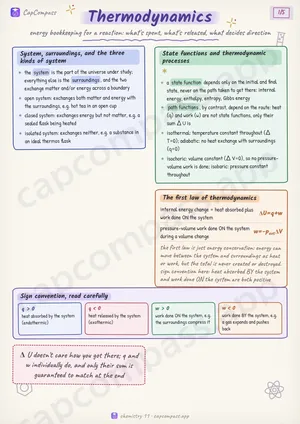
System, surroundings, and the three kinds of system
- the system is the part of the universe under study; everything else is the surroundings, and the two exchange matter and/or energy across a boundary
- open system: exchanges both matter and energy with the surroundings, e.g. hot tea in an open cup
- closed system: exchanges energy but not matter, e.g. a sealed flask being heated
- isolated system: exchanges neither, e.g. a substance in an ideal thermos flask
State functions and thermodynamic processes
- a state function depends only on the initial and final state, never on the path taken to get there: internal energy, enthalpy, entropy, Gibbs energy
- path functions, by contrast, depend on the route: heat (q) and work (w) are not state functions, only their sum Δ U is
- isothermal: temperature constant throughout (Δ T=0); adiabatic: no heat exchange with surroundings (q=0)
- isochoric: volume constant (Δ V=0), so no pressure-volume work is done; isobaric: pressure constant throughout
The first law of thermodynamics
- internal energy change = heat absorbed plus work done ON the system
Δ U=q+w - pressure-volume work done ON the system during a volume change
w=-p_extΔ V
Sign convention, read carefully
- q > 0: heat absorbed by the system (endothermic)
- q < 0: heat released by the system (exothermic)
- w > 0: work done ON the system, e.g. the surroundings compress it
- w < 0: work done BY the system, e.g. a gas expands and pushes back
Page 1 of 5. The full sheet, all 5 pages, opens free in the app.
What this Thermodynamics sheet covers
- System, surroundings, and the three kinds of system
- State functions and thermodynamic processes
- The first law of thermodynamics
- internal energy change = heat absorbed plus work done ON the system
- pressure-volume work done ON the system during a volume change
- Sign convention, read carefully
- q > 0
- q < 0
- w > 0
- w < 0
- Enthalpy
- enthalpy, defined from internal energy
- enthalpy change at constant pressure
- for a reaction involving ideal gases
- Exothermic and endothermic reactions
- Standard enthalpies: naming the conditions
- Hess's law
- total enthalpy change is the same however many steps the path is broken into
- Worked: Hess's law, target reaction from two given steps
- Bond enthalpy
- Entropy: a measure of disorder
- Gibbs free energy
- Gibbs energy, combining enthalpy and entropy at temperature T
- Spontaneity from the signs of ΔH and ΔS
- Worked: is a reaction spontaneous at 400 K
- Relating ΔG to the equilibrium constant
- Traps that cost marks
- Tricks that save time
How CapCompass uses this sheet
These notes are not a standalone PDF. CapCompass plans Chemistry chapter by chapter against your real exam dates and free hours, and when the plan reaches Thermodynamics the sheet opens inside the study block itself — at the page covering the sub-topic that block is on, with the timer still running. Revision arrives at the moment the plan says revise, instead of having to be gone looking for.