Redox Reactions — Class 11 CBSE Chemistry revision notes
A 4-page visual revision sheet for Redox Reactions, written for Class 11 CBSE Chemistry. Formulas, diagrams and the traps that cost marks, laid out to be read the night before rather than the term before. Free, and it opens inside CapCompass.
 Page 1 as PDF
Redox Reactions in one look
one species loses electrons, another gains them, and it happens in the same breath
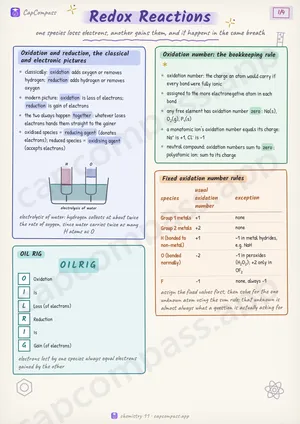
Oxidation and reduction, the classical and electronic pictures
- classically: oxidation adds oxygen or removes hydrogen; reduction adds hydrogen or removes oxygen
- modern picture: oxidation is loss of electrons; reduction is gain of electrons
- the two always happen together: whatever loses electrons hands them straight to the gainer
- oxidised species = reducing agent (donates electrons); reduced species = oxidising agent (accepts electrons)
OIL RIG
OILRIG — electrons lost by one species always equal electrons gained by the other
Oxidation number: the bookkeeping rule
- oxidation number: the charge an atom would carry if every bond were fully ionic
- assigned to the more electronegative atom in each bond
- any free element has oxidation number zero: Na(s), O_2(g), P_4(s)
- a monatomic ion's oxidation number equals its charge: Na^+ is +1, Cl^- is -1
- neutral compound: oxidation numbers sum to zero; polyatomic ion: sum to its charge
Fixed oxidation number rules
| species | usual oxidation number | exception |
|---|---|---|
| Group 1 metals | +1 | none |
| Group 2 metals | +2 | none |
| H (bonded to non-metal) | +1 | -1 in metal hydrides, e.g. NaH |
| O (bonded normally) | -2 | -1 in peroxides (H_2O_2); +2 only in OF_2 |
| F | -1 | none, always -1 |
Page 1 of 4. The full sheet, all 4 pages, opens free in the app.
What this Redox Reactions sheet covers
- Oxidation and reduction, the classical and electronic pictures
- OIL RIG
- Oxidation number: the bookkeeping rule
- Fixed oxidation number rules
- Worked: oxidation number of Mn in KMnO4
- Disproportionation, looked at closely
- Oxidising agent and reducing agent
- Oxidising agent
- Reducing agent
- Balancing redox equations: the oxidation number method
- Balancing by the ion-electron (half-reaction) method
- Worked: balancing Fe2+ and MnO4- in acidic medium
- Redox couples, electrode potential, and titrations
- Predicting spontaneity from electrode potentials
- cell potential from the two half-cell potentials
- Traps that cost marks
- Tricks that save time
How CapCompass uses this sheet
These notes are not a standalone PDF. CapCompass plans Chemistry chapter by chapter against your real exam dates and free hours, and when the plan reaches Redox Reactions the sheet opens inside the study block itself — at the page covering the sub-topic that block is on, with the timer still running. Revision arrives at the moment the plan says revise, instead of having to be gone looking for.