Equilibrium — Class 11 CBSE Chemistry revision notes
A 5-page visual revision sheet for Equilibrium, written for Class 11 CBSE Chemistry. Formulas, diagrams and the traps that cost marks, laid out to be read the night before rather than the term before. Free, and it opens inside CapCompass.
 Page 1 as PDF
Equilibrium in one look
forward and reverse running at the same rate, not stopped, just balanced
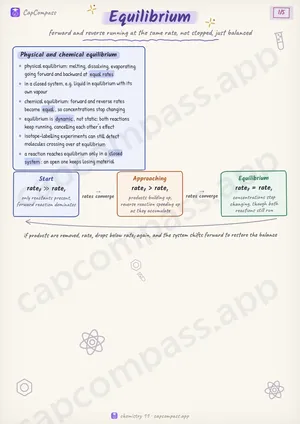
Physical and chemical equilibrium
- physical equilibrium: melting, dissolving, evaporating going forward and backward at equal rates
- in a closed system, e.g. liquid in equilibrium with its own vapour
- chemical equilibrium: forward and reverse rates become equal, so concentrations stop changing
- equilibrium is dynamic, not static: both reactions keep running, cancelling each other's effect
- isotope-labelling experiments can still detect molecules crossing over at equilibrium
- a reaction reaches equilibrium only in a closed system: an open one keeps losing material
- Start: only reactants present, forward reaction dominates
- Approaching: products building up, reverse reaction speeding up as they accumulate
- Equilibrium: concentrations stop changing, though both reactions still run
Page 1 of 5. The full sheet, all 5 pages, opens free in the app.
What this Equilibrium sheet covers
- Physical and chemical equilibrium
- Start
- Approaching
- Equilibrium
- Law of mass action and the equilibrium constant
- Kc and Kp, and how they relate
- K_p, the same expression written in partial pressures
- the two are linked through the ideal gas law
- Reading K: which side the reaction favours
- Worked: finding Kc from equilibrium concentrations
- Le Chatelier's principle
- Temperature's effect: exothermic vs endothermic
- Forward exothermic
- Forward endothermic
- Ionic equilibrium: acids and bases
- The ionic product of water and pH
- water's self-ionisation
- pH, a compressed scale for [H^+]
- pH and pOH always sum to 14 at 298 K
- Strong vs weak, and the dissociation constants
- pH of a weak acid, and Ka/Kb linkage
- approximate [H^+] for a weak acid of concentration c, when dissociation is small
- a conjugate acid-base pair's constants are linked through K_w
- Buffers: solutions that resist pH change
- Henderson-Hasselbalch equation
- pH of an acidic buffer, from Ka and the salt-to-acid ratio
- Solubility product, Ksp
- Precipitation: comparing IP to Ksp
- Worked: solubility from Ksp
- Traps that cost marks
- Tricks that save time
How CapCompass uses this sheet
These notes are not a standalone PDF. CapCompass plans Chemistry chapter by chapter against your real exam dates and free hours, and when the plan reaches Equilibrium the sheet opens inside the study block itself — at the page covering the sub-topic that block is on, with the timer still running. Revision arrives at the moment the plan says revise, instead of having to be gone looking for.