Structure of Atom — Class 11 CBSE Chemistry revision notes
A 4-page visual revision sheet for Structure of Atom, written for Class 11 CBSE Chemistry. Formulas, diagrams and the traps that cost marks, laid out to be read the night before rather than the term before. Free, and it opens inside CapCompass.
 Page 1 as PDF
Structure of Atom in one look
one nucleus, a set of shells, and rules for who lives where
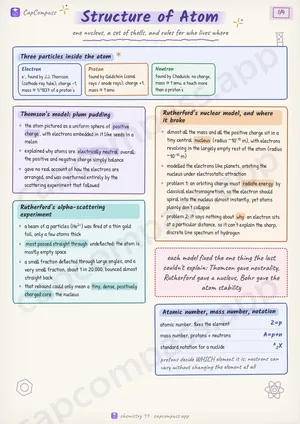
Three particles inside the atom
- Electron: e^-, found by J.J. Thomson (cathode ray tube); charge -1, mass ≈ 1/1837 of a proton's
- Proton: found by Goldstein (canal rays / anode rays); charge +1, mass ≈ 1 amu
- Neutron: found by Chadwick; no charge, mass ≈ 1 amu, a touch more than a proton's
Thomson's model: plum pudding
- the atom pictured as a uniform sphere of positive charge, with electrons embedded in it like seeds in a melon
- explained why atoms are electrically neutral overall: the positive and negative charge simply balance
- gave no real account of how the electrons are arranged, and was overturned entirely by the scattering experiment that followed
Rutherford's alpha-scattering experiment
- a beam of α particles (He^2+) was fired at a thin gold foil, only a few atoms thick
- most passed straight through undeflected: the atom is mostly empty space
- a small fraction deflected through large angles, and a very small fraction, about 1 in 20,000, bounced almost straight back
- that rebound could only mean a tiny, dense, positively charged core: the nucleus
Rutherford's nuclear model, and where it broke
- almost all the mass and all the positive charge sit in a tiny central nucleus (radius ~10^-15 m), with electrons revolving in the largely empty rest of the atom (radius ~10^-10 m)
- modelled the electrons like planets, orbiting the nucleus under electrostatic attraction
- problem 1: an orbiting charge must radiate energy by classical electromagnetism, so the electron should spiral into the nucleus almost instantly, yet atoms plainly don't collapse
- problem 2: it says nothing about why an electron sits at a particular distance, so it can't explain the sharp, discrete line spectrum of hydrogen
Atomic number, mass number, notation
- atomic number, fixes the element
Z=p - mass number, protons + neutrons
A=p+n - standard notation for a nuclide
^A_ZX
Page 1 of 4. The full sheet, all 4 pages, opens free in the app.
What this Structure of Atom sheet covers
- Three particles inside the atom
- Electron
- Proton
- Neutron
- Thomson's model: plum pudding
- Rutherford's alpha-scattering experiment
- Rutherford's nuclear model, and where it broke
- Atomic number, mass number, notation
- atomic number, fixes the element
- mass number, protons + neutrons
- standard notation for a nuclide
- Isotopes vs isobars
- Bohr's postulates
- Bohr model results, for H and hydrogen-like ions
- radius of the nth orbit
- energy of the nth orbit
- any transition: Rydberg formula
- Hydrogen's spectral series
- Lyman
- Balmer
- Paschen
- Brackett / Pfund
- Limitations of Bohr's model
- Dual nature of matter: de Broglie
- wavelength associated with a moving particle
- Heisenberg's uncertainty principle
- position and momentum can't both be known exactly
- Quantum mechanical model, in brief
- The four quantum numbers
- n: principal
- l: azimuthal
- ml: magnetic
- ms: spin
- Shapes of s, p, d orbitals
- s orbital
- p orbital
- d orbital
- Aufbau principle: the (n+l) rule
- Pauli exclusion & Hund's rule
- Electronic configuration: the exceptions
- Traps that cost marks
- Tricks that save time
How CapCompass uses this sheet
These notes are not a standalone PDF. CapCompass plans Chemistry chapter by chapter against your real exam dates and free hours, and when the plan reaches Structure of Atom the sheet opens inside the study block itself — at the page covering the sub-topic that block is on, with the timer still running. Revision arrives at the moment the plan says revise, instead of having to be gone looking for.