Organic Chemistry – Some Basic Principles and Techniques — Class 11 CBSE Chemistry revision notes
A 4-page visual revision sheet for Organic Chemistry – Some Basic Principles and Techniques, written for Class 11 CBSE Chemistry. Formulas, diagrams and the traps that cost marks, laid out to be read the night before rather than the term before. Free, and it opens inside CapCompass.
 Page 1 as PDF
Organic Chemistry – Some Basic Principles and Techniques in one look
one carbon skeleton, one functional group, and the rules that name and break both
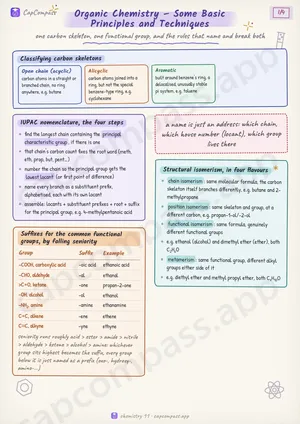
Classifying carbon skeletons
- Open chain (acyclic): carbon atoms in a straight or branched chain, no ring anywhere, e.g. butane
- Alicyclic: carbon atoms joined into a ring, but not the special benzene-type ring, e.g. cyclohexane
- Aromatic: built around benzene's ring, a delocalised, unusually stable pi system, e.g. toluene
IUPAC nomenclature, the four steps
- find the longest chain containing the principal characteristic group, if there is one
- that chain's carbon count fixes the root word (meth, eth, prop, but, pent…)
- number the chain so the principal group gets the lowest locant (or first point of difference)
- name every branch as a substituent prefix, alphabetised, each with its own locant
- assemble: locants + substituent prefixes + root + suffix for the principal group, e.g. 4-methylpentanoic acid
Suffixes for the common functional groups, by falling seniority
| Group | Suffix | Example |
|---|---|---|
| -COOH, carboxylic acid | -oic acid | ethanoic acid |
| -CHO, aldehyde | -al | ethanal |
| >C=O, ketone | -one | propan-2-one |
| -OH, alcohol | -ol | ethanol |
| -NH_2, amine | -amine | ethanamine |
| C=C, alkene | -ene | ethene |
| C≡C, alkyne | -yne | ethyne |
Structural isomerism, in four flavours
- chain isomerism: same molecular formula, the carbon skeleton itself branches differently, e.g. butane and 2-methylpropane
- position isomerism: same skeleton and group, at a different carbon, e.g. propan-1-ol/-2-ol
- functional isomerism: same formula, genuinely different functional groups
- e.g. ethanol (alcohol) and dimethyl ether (ether), both C_2H_6O
- metamerism: same functional group, different alkyl groups either side of it
- e.g. diethyl ether and methyl propyl ether, both C_4H_10O
Page 1 of 4. The full sheet, all 4 pages, opens free in the app.
What this Organic Chemistry – Some Basic Principles and Techniques sheet covers
- Classifying carbon skeletons
- Open chain (acyclic)
- Alicyclic
- Aromatic
- IUPAC nomenclature, the four steps
- Suffixes for the common functional groups, by falling seniority
- Structural isomerism, in four flavours
- Stereoisomerism: same bonds, different arrangement in space
- Worked: classifying a reaction by type
- Inductive effect: a bond, not a jump
- Resonance, hyperconjugation, electromeric effect
- Reaction intermediates
- Carbocation
- Carbanion
- Free radical
- Carbene
- The three basic reaction types, by what happens to the bonds
- Purification techniques, matched to what's wrong with the sample
- Things to remember before the traps
- Traps that cost marks
- Tricks that save time
How CapCompass uses this sheet
These notes are not a standalone PDF. CapCompass plans Chemistry chapter by chapter against your real exam dates and free hours, and when the plan reaches Organic Chemistry – Some Basic Principles and Techniques the sheet opens inside the study block itself — at the page covering the sub-topic that block is on, with the timer still running. Revision arrives at the moment the plan says revise, instead of having to be gone looking for.