The p-Block Elements (Group 13 and 14) — Class 11 CBSE Chemistry revision notes
A 5-page visual revision sheet for The p-Block Elements (Group 13 and 14), written for Class 11 CBSE Chemistry. Formulas, diagrams and the traps that cost marks, laid out to be read the night before rather than the term before. Free, and it opens inside CapCompass.
 Page 1 as PDF
The p-Block Elements (Group 13 and 14) in one look
boron's family and carbon's family, and the one anomaly each has at its head
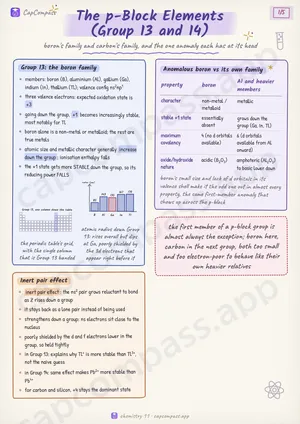
Group 13: the boron family
- members: boron (B), aluminium (Al), gallium (Ga), indium (In), thallium (Tl); valence config ns^2np^1
- three valence electrons: expected oxidation state is +3
- going down the group, +1 becomes increasingly stable, most notably for Tl
- boron alone is a non-metal or metalloid; the rest are true metals
- atomic size and metallic character generally increase down the group; ionisation enthalpy falls
- the +1 state gets more STABLE down the group, so its reducing power FALLS
Inert pair effect
- inert pair effect: the ns^2 pair grows reluctant to bond as Z rises down a group
- it stays back as a lone pair instead of being used
- strengthens down a group: ns electrons sit close to the nucleus
- poorly shielded by the d and f electrons lower in the group, so held tightly
- in Group 13: explains why Tl^+ is more stable than Tl^3+, not the naive guess
- in Group 14: same effect makes Pb^2+ more stable than Pb^4+
- for carbon and silicon, +4 stays the dominant state
Anomalous boron vs its own family
| property | boron | Al and heavier members |
|---|---|---|
| character | non-metal / metalloid | metallic |
| stable +1 state | essentially absent | grows down the group (Ga, In, Tl) |
| maximum covalency | 4 (no d orbitals available) | 6 (d orbitals available from Al onward) |
| oxide/hydroxide nature | acidic (B_2O_3) | amphoteric (Al_2O_3) to basic lower down |
Page 1 of 5. The full sheet, all 5 pages, opens free in the app.
What this The p-Block Elements (Group 13 and 14) sheet covers
- Group 13: the boron family
- Inert pair effect
- Anomalous boron vs its own family
- Boron's electron deficiency
- Important Group 13 compounds
- Worked: predicting the stable oxidation state down Group 13
- Group 14: the carbon family
- Why carbon differs from the rest of its group
- Allotropes of carbon: diamond vs graphite
- Diamond
- Graphite
- Fullerenes: the third crystalline face of carbon
- Important Group 14 compounds
- Worked: why is CO2 a gas but SiO2 a high-melting solid?
- Traps that cost marks
- Tricks that save time
How CapCompass uses this sheet
These notes are not a standalone PDF. CapCompass plans Chemistry chapter by chapter against your real exam dates and free hours, and when the plan reaches The p-Block Elements (Group 13 and 14) the sheet opens inside the study block itself — at the page covering the sub-topic that block is on, with the timer still running. Revision arrives at the moment the plan says revise, instead of having to be gone looking for.