Real Numbers — Class 9 Maharashtra SSC Mathematics revision notes
A 3-page visual revision sheet for Real Numbers, written for Class 9 Maharashtra SSC Mathematics. Formulas, diagrams and the traps that cost marks, laid out to be read the night before rather than the term before. Free, and it opens inside CapCompass.
 Page 1 as PDF
Real Numbers in one look
how the number families nest, what makes a decimal rational, and working with surds
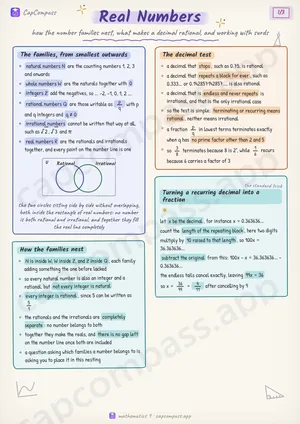
The families, from smallest outwards
- natural numbers N are the counting numbers 1, 2, 3 and onwards
- whole numbers W are the naturals together with 0
- integers Z add the negatives, so ... -2, -1, 0, 1, 2 ...
- rational numbers Q are those writable as p/q with p and q integers and q ≠ 0
- irrational numbers cannot be written that way at all, such as √2, √3 and π
- real numbers R are the rationals and irrationals together, and every point on the number line is one
How the families nest
- N is inside W, W inside Z, and Z inside Q, each family adding something the one before lacked
- so every natural number is also an integer and a rational, but not every integer is natural
- every integer is rational, since 5 can be written as 5/1
- the rationals and the irrationals are completely separate: no number belongs to both
- together they make the reals, and there is no gap left on the number line once both are included
- a question asking which families a number belongs to is asking you to place it in this nesting
The decimal test
- a decimal that stops, such as 0.75, is rational
- a decimal that repeats a block for ever, such as 0.333... or 0.142857142857..., is also rational
- a decimal that is endless and never repeats is irrational, and that is the only irrational case
- so the test is simple: terminating or recurring means rational, neither means irrational
- a fraction p/q in lowest terms terminates exactly when q has no prime factor other than 2 and 5
- so 3/8 terminates because 8 is 2³, while 1/6 recurs because 6 carries a factor of 3
Turning a recurring decimal into a fraction
- let x be the decimal, for instance x = 0.363636...
- count the length of the repeating block, here two digits
- multiply by 10 raised to that length, so 100x = 36.363636...
- subtract the original from this: 100x - x = 36.363636... - 0.363636...
- the endless tails cancel exactly, leaving 99x = 36
- so x = 36/99 = 4/11 after cancelling by 9
Page 1 of 3. The full sheet, all 3 pages, opens free in the app.
What this Real Numbers sheet covers
- Natural numbers
- Integers
- Rational numbers
- Irrational numbers
- The families, from smallest outwards
- How the families nest
- Terminating decimal
- Recurring decimal
- The decimal test
- Recurring decimal to fraction
- Turning a recurring decimal into a fraction
- A decimal with a non repeating start
- Surd
- Rationalisation
- Conjugate
- Surds and how to handle them
- The surd rules
- a product under one root splits
- and so does a quotient
- a single root in the denominator
- the conjugate clears a two term denominator
- the identity the conjugate relies on
- Rationalising with a conjugate
- Placing a number in its families
- Traps that cost marks
- Tricks that save time
How CapCompass uses this sheet
These notes are not a standalone PDF. CapCompass plans Mathematics chapter by chapter against your real exam dates and free hours, and when the plan reaches Real Numbers the sheet opens inside the study block itself — at the page covering the sub-topic that block is on, with the timer still running. Revision arrives at the moment the plan says revise, instead of having to be gone looking for.