Aldehydes, Ketones and Carboxylic Acids — Class 12 CBSE Chemistry revision notes
A 4-page visual revision sheet for Aldehydes, Ketones and Carboxylic Acids, written for Class 12 CBSE Chemistry. Formulas, diagrams and the traps that cost marks, laid out to be read the night before rather than the term before. Free, and it opens inside CapCompass.
 Page 1 as PDF
Aldehydes, Ketones and Carboxylic Acids in one look
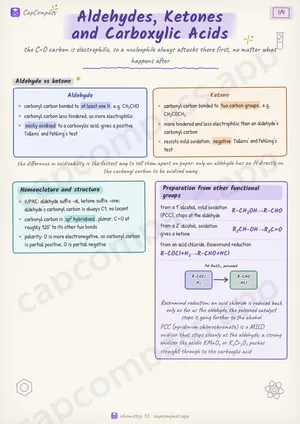
the C=O carbon is electrophilic, so a nucleophile always attacks there first, no matter what happens after
Aldehyde vs ketone
- carbonyl carbon bonded to at least one H, e.g. CH_3CHO
- carbonyl carbon less hindered, so more electrophilic
- easily oxidised to a carboxylic acid; gives a positive Tollens' and Fehling's test
- carbonyl carbon bonded to two carbon groups, e.g. CH_3COCH_3
- more hindered and less electrophilic than an aldehyde's carbonyl carbon
- resists mild oxidation; negative Tollens' and Fehling's test
Nomenclature and structure
- IUPAC: aldehyde suffix -al, ketone suffix -one; aldehyde's carbonyl carbon is always C1, no locant
- carbonyl carbon is sp^2 hybridised, planar, C=O at roughly 120° to its other two bonds
- polarity: O is more electronegative, so carbonyl carbon is partial positive, O is partial negative
Preparation from other functional groups
- from a 1° alcohol, mild oxidation (PCC), stops at the aldehyde
R-CH_2OHto R-CHO - from a 2° alcohol, oxidation gives a ketone
R_2CH-OHto R_2C=O - from an acid chloride, Rosenmund reduction
R-COCl+H_2to R-CHO+HCl
Page 1 of 4. The full sheet, all 4 pages, opens free in the app.
What this Aldehydes, Ketones and Carboxylic Acids sheet covers
- Aldehyde vs ketone
- Aldehyde
- Ketone
- Nomenclature and structure
- Preparation from other functional groups
- from a 1° alcohol, mild oxidation (PCC), stops at the aldehyde
- from a 2° alcohol, oxidation gives a ketone
- from an acid chloride, Rosenmund reduction
- Nucleophilic addition, the core mechanism
- Distinguishing aldehydes and ketones
- Iodoform test logic
- Aldol condensation vs Cannizzaro reaction
- Aldol condensation
- Cannizzaro reaction
- Oxidation and reduction of the carbonyl group
- aldehyde to acid, strong oxidiser
- carbonyl to alcohol, NaBH_4 or catalytic H_2/Ni
- Clemmensen reduction: carbonyl fully to CH_2
- Carboxylic acid acidity
- Ranking acid strength
- HVZ reaction and decarboxylation
- Symbols
- Traps that cost marks
- Tricks that save time
How CapCompass uses this sheet
These notes are not a standalone PDF. CapCompass plans Chemistry chapter by chapter against your real exam dates and free hours, and when the plan reaches Aldehydes, Ketones and Carboxylic Acids the sheet opens inside the study block itself — at the page covering the sub-topic that block is on, with the timer still running. Revision arrives at the moment the plan says revise, instead of having to be gone looking for.