Solid State — Class 12 CBSE Chemistry revision notes
A 7-page visual revision sheet for Solid State, written for Class 12 CBSE Chemistry. Formulas, diagrams and the traps that cost marks, laid out to be read the night before rather than the term before. Free, and it opens inside CapCompass.
 Page 1 as PDF
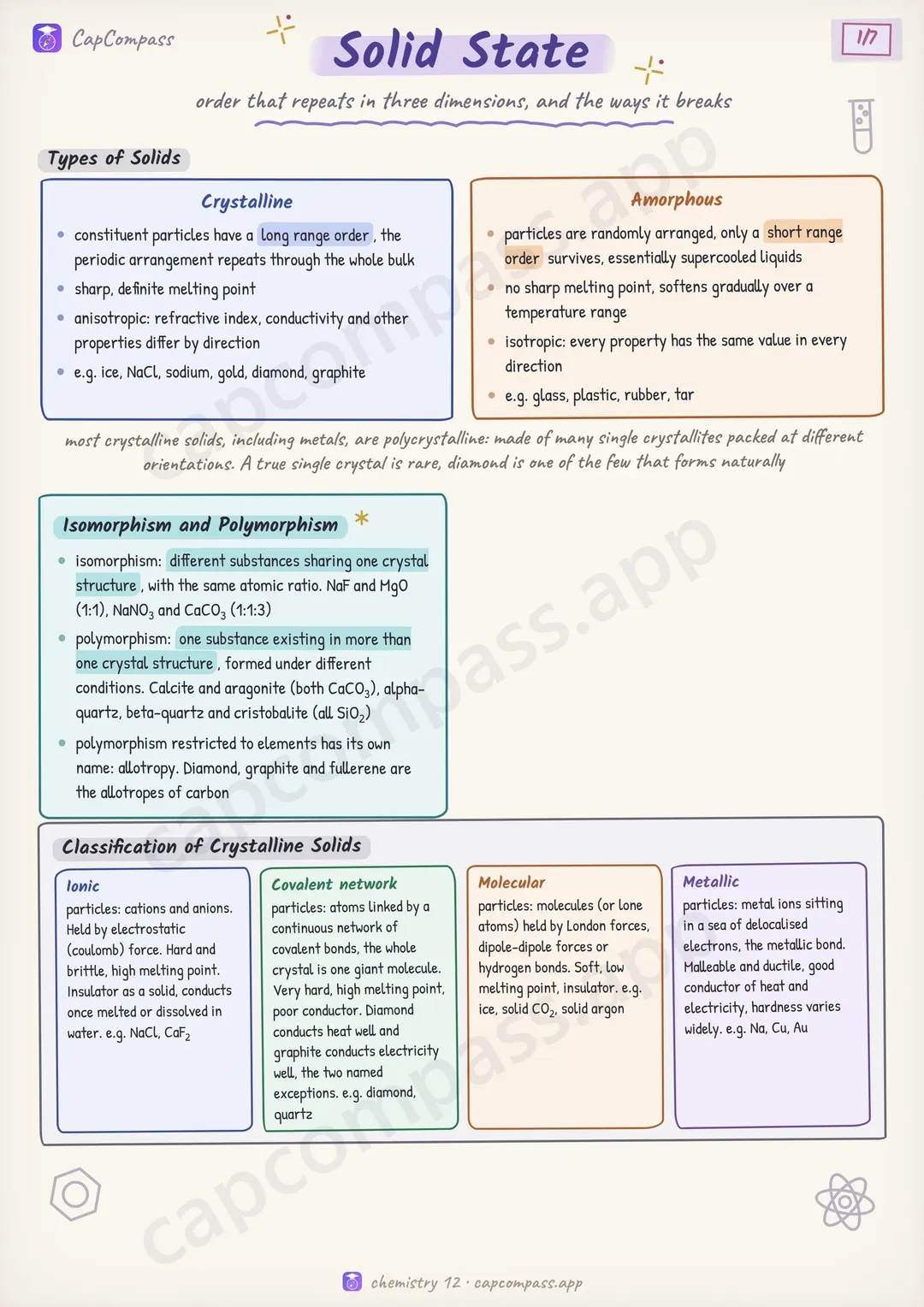
Solid State in one look
order that repeats in three dimensions, and the ways it breaks
Types of Solids
- constituent particles have a long range order, the periodic arrangement repeats through the whole bulk
- sharp, definite melting point
- anisotropic: refractive index, conductivity and other properties differ by direction
- e.g. ice, NaCl, sodium, gold, diamond, graphite
- particles are randomly arranged, only a short range order survives, essentially supercooled liquids
- no sharp melting point, softens gradually over a temperature range
- isotropic: every property has the same value in every direction
- e.g. glass, plastic, rubber, tar
Isomorphism and Polymorphism
- isomorphism: different substances sharing one crystal structure, with the same atomic ratio. NaF and MgO (1:1), NaNO3 and CaCO3 (1:1:3)
- polymorphism: one substance existing in more than one crystal structure, formed under different conditions. Calcite and aragonite (both CaCO3), alpha-quartz, beta-quartz and cristobalite (all SiO2)
- polymorphism restricted to elements has its own name: allotropy. Diamond, graphite and fullerene are the allotropes of carbon
Classification of Crystalline Solids
- Ionic: particles: cations and anions. Held by electrostatic (coulomb) force. Hard and brittle, high melting point. Insulator as a solid, conducts once melted or dissolved in water. e.g. NaCl, CaF2
- Covalent network: particles: atoms linked by a continuous network of covalent bonds, the whole crystal is one giant molecule. Very hard, high melting point, poor conductor. Diamond conducts heat well and graphite conducts electricity well, the two named exceptions. e.g. diamond, quartz
- Molecular: particles: molecules (or lone atoms) held by London forces, dipole-dipole forces or hydrogen bonds. Soft, low melting point, insulator. e.g. ice, solid CO2, solid argon
- Metallic: particles: metal ions sitting in a sea of delocalised electrons, the metallic bond. Malleable and ductile, good conductor of heat and electricity, hardness varies widely. e.g. Na, Cu, Au
Page 1 of 7. The full sheet, all 7 pages, opens free in the app.
What this Solid State sheet covers
- Types of Solids
- Crystalline
- Amorphous
- Isomorphism and Polymorphism
- Classification of Crystalline Solids
- Ionic
- Covalent network
- Molecular
- Metallic
- basis
- unit cell
- Crystal Lattices and Unit Cells
- Types of Unit Cell
- The Seven Crystal Systems
- Cubic System and Number of Particles
- sc
- bcc
- fcc
- Formula from Unit Cell Occupancy, worked
- molar mass
- unit cell dimensions
- Density Calculations
- mass of one unit cell, n particles of mass m each
- density of the unit cell (equals the substance's density)
- mass of one particle from the molar mass M
- combining the two gives the working equation
- number of particles in x g of the substance
- number of unit cells in x g of the substance
- Density from a Unit Cell, worked
- Atoms and Unit Cells from Mass, worked
- Close Packing and Coordination Number
- hcp vs ccp (fcc) Stacking
- hcp
- ccp / fcc
- Voids
- Voids from Moles, worked
- Packing Efficiency
- simple cubic (sc): spheres touch along the edge
- body centred cubic (bcc): spheres touch along the body diagonal
- face centred cubic (fcc, ccp): spheres touch along the face diagonal
- Defects & Properties
- Defects and Properties
- Defects
- Schottky and Frenkel Defects
- Schottky
- Frenkel
- Impurity Defects
- Defect Effect on Density, at a Glance
- Vacancy
- Self-interstitial, extra particle
- Self-interstitial, shifted
- Non-stoichiometric Defects
- Electrical Properties and Band Theory
- Band Gaps, E_gap in eV
- Metals vs Semiconductors
- Metals
- Semiconductors
- Semiconductors and Doping
- Magnetic Properties
- Traps that cost marks
- Tricks that save time
How CapCompass uses this sheet
These notes are not a standalone PDF. CapCompass plans Chemistry chapter by chapter against your real exam dates and free hours, and when the plan reaches Solid State the sheet opens inside the study block itself — at the page covering the sub-topic that block is on, with the timer still running. Revision arrives at the moment the plan says revise, instead of having to be gone looking for.