Solutions — Class 12 CBSE Chemistry revision notes
A 5-page visual revision sheet for Solutions, written for Class 12 CBSE Chemistry. Formulas, diagrams and the traps that cost marks, laid out to be read the night before rather than the term before. Free, and it opens inside CapCompass.
 Page 1 as PDF
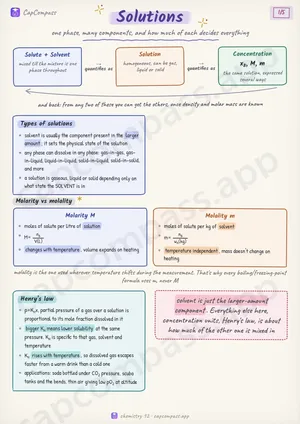
Solutions in one look
one phase, many components, and how much of each decides everything
- Solute + Solvent: mixed till the mixture is one phase throughout
- Solution: homogeneous, can be gas, liquid or solid
- Concentration: the same solution, expressed several ways
Types of solutions
- solvent is usually the component present in the larger amount; it sets the physical state of the solution
- any phase can dissolve in any phase: gas-in-gas, gas-in-liquid, liquid-in-liquid, solid-in-liquid, solid-in-solid, and more
- a solution is gaseous, liquid or solid depending only on what state the SOLVENT is in
Molarity vs molality
- moles of solute per litre of solution
- M=n_B/V(L)
- changes with temperature, volume expands on heating
- moles of solute per kg of solvent
- m=n_B/w_A(kg)
- temperature independent, mass doesn't change on heating
Henry's law
- p=K_Hx, partial pressure of a gas over a solution is proportional to its mole fraction dissolved in it
- bigger K_H means lower solubility at the same pressure. K_H is specific to that gas, solvent and temperature
- K_H rises with temperature, so dissolved gas escapes faster from a warm drink than a cold one
- applications: soda bottled under CO_2 pressure, scuba tanks and the bends, thin air giving low pO_2 at altitude
Page 1 of 5. The full sheet, all 5 pages, opens free in the app.
What this Solutions sheet covers
- Solute + Solvent
- Solution
- Concentration
- Types of solutions
- Molarity vs molality
- Molarity M
- Molality m
- Henry's law
- Raoult's law, liquid-liquid solutions
- mass percentage, w/w
- mole fraction of solute
- partial vapour pressure of each component
- total vapour pressure
- Ideal vs non-ideal solutions
- Ideal
- Non-ideal
- Positive vs negative deviation
- Positive deviation
- Negative deviation
- Vapour pressure and volatility
- What makes a property colligative
- Relative lowering of vapour pressure
- dilute solution, non-volatile solute
- Boiling point elevation
- elevation: the boiling point ==rises==
- K_b: molal elevation constant, a solvent property
- molar mass of solute from Δ T_b
- Freezing point depression
- depression: the freezing point ==falls==
- K_f: molal depression constant, a solvent property
- molar mass of solute from Δ T_f
- Osmotic pressure and reverse osmosis
- dilute solution
- C in moles per volume
- molar mass of solute from π
- Symbols
- van't Hoff factor
- observed over calculated (no dissociation/association) value
- equivalently, normal molar mass over the observed (abnormal) one
- Dissociation vs association
- Dissociation, i > 1
- Association, i < 1
- i modifies every colligative formula
- osmotic pressure
- Abnormal molar mass
- Traps that cost marks
- Tricks that save time
How CapCompass uses this sheet
These notes are not a standalone PDF. CapCompass plans Chemistry chapter by chapter against your real exam dates and free hours, and when the plan reaches Solutions the sheet opens inside the study block itself — at the page covering the sub-topic that block is on, with the timer still running. Revision arrives at the moment the plan says revise, instead of having to be gone looking for.