Coordination Compounds — Class 12 CBSE Chemistry revision notes
A 4-page visual revision sheet for Coordination Compounds, written for Class 12 CBSE Chemistry. Formulas, diagrams and the traps that cost marks, laid out to be read the night before rather than the term before. Free, and it opens inside CapCompass.
 Page 1 as PDF
Coordination Compounds in one look
a metal in the middle, ligands donating a pair each, and one number that fixes the shape
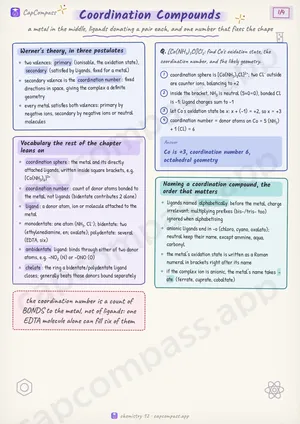
Werner's theory, in three postulates
- two valences: primary (ionisable, the oxidation state), secondary (satisfied by ligands, fixed for a metal)
- secondary valence is the coordination number: fixed directions in space, giving the complex a definite geometry
- every metal satisfies both valences: primary by negative ions, secondary by negative ions or neutral molecules
Vocabulary the rest of the chapter leans on
- coordination sphere: the metal and its directly attached ligands, written inside square brackets, e.g. [Co(NH_3)_6]^3+
- coordination number: count of donor atoms bonded to the metal, not ligands (bidentate contributes 2 alone)
- ligand: a donor atom, ion or molecule attached to the metal
- monodentate: one atom (NH_3, Cl^-); bidentate: two (ethylenediamine, en; oxalate); polydentate: several (EDTA, six)
- ambidentate ligand: binds through either of two donor atoms, e.g. -NO_2 (N) or -ONO (O)
- chelate: the ring a bidentate/polydentate ligand closes; generally beats those donors bound separately
Q. [Co(NH_3)_5Cl]Cl_2: find Co's oxidation state, the coordination number, and the likely geometry.
- coordination sphere is [Co(NH_3)_5Cl]^2+; two Cl^- outside are counter ions, balancing to +2
- inside the bracket, NH_3 is neutral (5×0=0), bonded Cl is -1: ligand charges sum to -1
- let Co's oxidation state be x: x + (-1) = +2, so x = +3
- coordination number = donor atoms on Co = 5 (NH_3) + 1 (Cl) = 6
Answer: Co is +3, coordination number 6, octahedral geometry
Naming a coordination compound, the order that matters
- ligands named alphabetically before the metal, charge irrelevant; multiplying prefixes (bis-/tris- too) ignored when alphabetising
- anionic ligands end in -o (chloro, cyano, oxalato); neutral keep their name, except ammine, aqua, carbonyl
- the metal's oxidation state is written as a Roman numeral in brackets right after its name
- if the complex ion is anionic, the metal's name takes -ate (ferrate, cuprate, cobaltate)
Page 1 of 4. The full sheet, all 4 pages, opens free in the app.
What this Coordination Compounds sheet covers
- Werner's theory, in three postulates
- Vocabulary the rest of the chapter leans on
- Naming a coordination compound, the order that matters
- Common ligand names
- Bonding: valence bond theory's picture
- Crystal field theory: splitting the d orbitals
- Spin state from the spectrochemical series
- Stereoisomerism, the two kinds
- Applications worth remembering
- Things to remember before the traps
- Traps that cost marks
- Tricks that save time
How CapCompass uses this sheet
These notes are not a standalone PDF. CapCompass plans Chemistry chapter by chapter against your real exam dates and free hours, and when the plan reaches Coordination Compounds the sheet opens inside the study block itself — at the page covering the sub-topic that block is on, with the timer still running. Revision arrives at the moment the plan says revise, instead of having to be gone looking for.