Biomolecules — Class 12 CBSE Chemistry revision notes
A 4-page visual revision sheet for Biomolecules, written for Class 12 CBSE Chemistry. Formulas, diagrams and the traps that cost marks, laid out to be read the night before rather than the term before. Free, and it opens inside CapCompass.
 Page 1 as PDF
Biomolecules in one look
carbohydrates, proteins and nucleic acids are all polymers of a small, repeating chemical unit
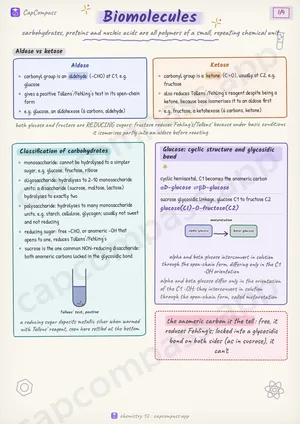
Aldose vs ketose
- carbonyl group is an aldehyde (-CHO) at C1, e.g. glucose
- gives a positive Tollens'/Fehling's test in its open-chain form
- e.g. glucose, an aldohexose (6 carbons, aldehyde)
- carbonyl group is a ketone (C=O), usually at C2, e.g. fructose
- also reduces Tollens'/Fehling's reagent despite being a ketone, because base isomerises it to an aldose first
- e.g. fructose, a ketohexose (6 carbons, ketone)
Classification of carbohydrates
- monosaccharide: cannot be hydrolysed to a simpler sugar, e.g. glucose, fructose, ribose
- oligosaccharide: hydrolyses to 2-10 monosaccharide units; a disaccharide (sucrose, maltose, lactose) hydrolyses to exactly two
- polysaccharide: hydrolyses to many monosaccharide units, e.g. starch, cellulose, glycogen; usually not sweet and not reducing
- reducing sugar: free -CHO, or anomeric -OH that opens to one, reduces Tollens'/Fehling's
- sucrose is the one common NON-reducing disaccharide: both anomeric carbons locked in the glycosidic bond
Glucose: cyclic structure and glycosidic bond
- cyclic hemiacetal, C1 becomes the anomeric carbon
α D-glucose rightleftharpoons β D-glucose - sucrose glycosidic linkage, glucose C1 to fructose C2
glucose(C1)-O-fructose(C2)
Page 1 of 4. The full sheet, all 4 pages, opens free in the app.
What this Biomolecules sheet covers
- Aldose vs ketose
- Aldose
- Ketose
- Classification of carbohydrates
- Glucose: cyclic structure and glycosidic bond
- cyclic hemiacetal, C1 becomes the anomeric carbon
- sucrose glycosidic linkage, glucose C1 to fructose C2
- Amino acids and the zwitterion
- Predicting the zwitterion at neutral pH
- The peptide bond
- condensation of two amino acids, water lost
- Protein secondary structure
- Alpha helix
- Beta pleated sheet
- Levels of protein structure
- Denaturation
- Enzymes and vitamins
- Nucleic acids: DNA vs RNA
- Symbols
- Traps that cost marks
- Tricks that save time
How CapCompass uses this sheet
These notes are not a standalone PDF. CapCompass plans Chemistry chapter by chapter against your real exam dates and free hours, and when the plan reaches Biomolecules the sheet opens inside the study block itself — at the page covering the sub-topic that block is on, with the timer still running. Revision arrives at the moment the plan says revise, instead of having to be gone looking for.