Chemical Kinetics — Class 12 CBSE Chemistry revision notes
A 4-page visual revision sheet for Chemical Kinetics, written for Class 12 CBSE Chemistry. Formulas, diagrams and the traps that cost marks, laid out to be read the night before rather than the term before. Free, and it opens inside CapCompass.
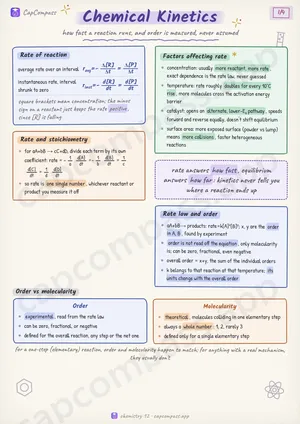 Page 1 as PDF
Chemical Kinetics in one look
how fast a reaction runs, and order is measured, never assumed
Rate of reaction
- average rate over an interval
r_avg=-Δ[R]/Δ t=Δ[P]/Δ t - instantaneous rate, interval shrunk to zero
r_inst=-d[R]/dt=d[P]/dt
Rate and stoichiometry
- for aA+bB to cC+dD, divide each term by its own coefficient: rate = -1/ad[A]/dt=-1/bd[B]/dt=1/cd[C]/dt=1/dd[D]/dt
- so rate is one single number, whichever reactant or product you measure it off
Factors affecting rate
- concentration: usually more reactant, more rate, exact dependence is the rate law, never guessed
- temperature: rate roughly doubles for every 10°C rise, more molecules cross the activation energy barrier
- catalyst: opens an alternate, lower-E_a pathway, speeds forward and reverse equally, doesn't shift equilibrium
- surface area: more exposed surface (powder vs lump) means more collisions, faster heterogeneous reactions
Rate law and order
- aA+bBto products: rate=k[A]^x[B]^y; x, y are the order in A, B, found by experiment
- order is not read off the equation, only molecularity is; can be zero, fractional, even negative
- overall order = x+y, the sum of the individual orders
- k belongs to that reaction at that temperature; its units change with the overall order
Order vs molecularity
- experimental, read from the rate law
- can be zero, fractional, or negative
- defined for the overall reaction, any step or the net one
- theoretical, molecules colliding in one elementary step
- always a whole number: 1, 2, rarely 3
- defined only for a single elementary step
Page 1 of 4. The full sheet, all 4 pages, opens free in the app.
What this Chemical Kinetics sheet covers
- Rate of reaction
- average rate over an interval
- instantaneous rate, interval shrunk to zero
- Rate and stoichiometry
- Factors affecting rate
- Rate law and order
- Order vs molecularity
- Order
- Molecularity
- Rate constant units by order
- zero order
- first order
- second order
- integrated rate equation
- half-life
- integrated rate equation, exponential form
- log form
- same, base-10
- First order: special cases
- Zero order vs first order, plotted
- Reading graphs, both orders
- Arrhenius equation
- rate constant vs temperature
- two-temperature form
- Effect of a catalyst
- Collision theory
- Rate constant from collision theory
- collision theory form
- Symbols
- Traps that cost marks
- Tricks that save time
How CapCompass uses this sheet
These notes are not a standalone PDF. CapCompass plans Chemistry chapter by chapter against your real exam dates and free hours, and when the plan reaches Chemical Kinetics the sheet opens inside the study block itself — at the page covering the sub-topic that block is on, with the timer still running. Revision arrives at the moment the plan says revise, instead of having to be gone looking for.