The p-Block Elements — Class 12 CBSE Chemistry revision notes
A 4-page visual revision sheet for The p-Block Elements, written for Class 12 CBSE Chemistry. Formulas, diagrams and the traps that cost marks, laid out to be read the night before rather than the term before. Free, and it opens inside CapCompass.
 Page 1 as PDF
The p-Block Elements in one look
nitrogen through the noble gases, four groups that get less reactive from the top and more reluctant from the right
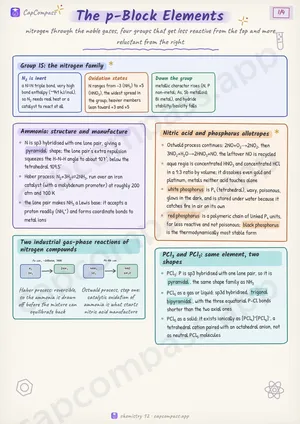
Group 15: the nitrogen family
- N2 is inert: a N≡N triple bond, very high bond enthalpy (~941 kJ/mol), so N_2 needs real heat or a catalyst to react at all
- Oxidation states: N ranges from -3 (NH_3) to +5 (HNO_3), the widest spread in the group; heavier members lean toward +3 and +5
- Down the group: metallic character rises (N, P non-metal; As, Sb metalloid; Bi metal), and hydride stability/basicity falls
Ammonia: structure and manufacture
- N is sp3 hybridised with one lone pair, giving a pyramidal shape; the lone pair's extra repulsion squeezes the H-N-H angle to about 107°, below the tetrahedral 109.5°
- Haber process: N_2+3H_2rightleftharpoons 2NH_3, run over an iron catalyst (with a molybdenum promoter) at roughly 200 atm and 700 K
- the lone pair makes NH_3 a Lewis base: it accepts a proton readily (NH_4^+) and forms coordinate bonds to metal ions
Nitric acid and phosphorus allotropes
- Ostwald process continues: 2NO+O_2→ 2NO_2, then 3NO_2+H_2O→ 2HNO_3+NO, the leftover NO is recycled
- aqua regia is concentrated HNO_3 and concentrated HCl in a 1:3 ratio by volume; it dissolves even gold and platinum, metals neither acid touches alone
- white phosphorus is P_4 (tetrahedral), waxy, poisonous, glows in the dark, and is stored under water because it catches fire in air on its own
- red phosphorus is a polymeric chain of linked P_4 units, far less reactive and not poisonous; black phosphorus is the thermodynamically most stable form
PCl3 and PCl5: same element, two shapes
- PCl_3: P is sp3 hybridised with one lone pair, so it is pyramidal, the same shape family as NH_3
- PCl_5 as a gas or liquid: sp3d hybridised, trigonal bipyramidal, with the three equatorial P-Cl bonds shorter than the two axial ones
- PCl_5 as a solid: it exists ionically as [PCl_4]^+[PCl_6]^-, a tetrahedral cation paired with an octahedral anion, not as neutral PCl_5 molecules
Page 1 of 4. The full sheet, all 4 pages, opens free in the app.
What this The p-Block Elements sheet covers
- Group 15: the nitrogen family
- N2 is inert
- Oxidation states
- Down the group
- Ammonia: structure and manufacture
- Two industrial gas-phase reactions of nitrogen compounds
- Nitric acid and phosphorus allotropes
- PCl3 and PCl5: same element, two shapes
- Group 16: oxygen and its allotropes
- O2
- O3, ozone
- Sulphur allotropes
- SO2 and the Contact process for H2SO4
- Contact process, the catalytic step
- Group 17: the halogens, general trends
- Group 17, marked across the table
- Interhalogen compounds
- Group 18: the noble gases
- The reaction that put noble-gas chemistry on the map
- Things to remember before the traps
- Traps that cost marks
- Tricks that save time
How CapCompass uses this sheet
These notes are not a standalone PDF. CapCompass plans Chemistry chapter by chapter against your real exam dates and free hours, and when the plan reaches The p-Block Elements the sheet opens inside the study block itself — at the page covering the sub-topic that block is on, with the timer still running. Revision arrives at the moment the plan says revise, instead of having to be gone looking for.