Electrochemistry — Class 12 CBSE Chemistry revision notes
A 4-page visual revision sheet for Electrochemistry, written for Class 12 CBSE Chemistry. Formulas, diagrams and the traps that cost marks, laid out to be read the night before rather than the term before. Free, and it opens inside CapCompass.
 Page 1 as PDF
Electrochemistry in one look
cells turn chemistry into current, and current back into chemistry
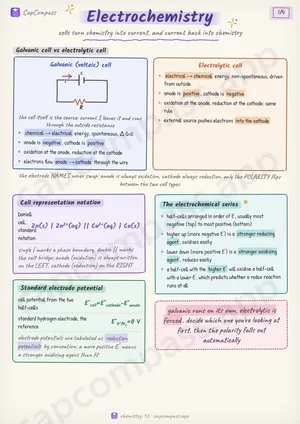
Galvanic cell vs electrolytic cell
- chemical → electrical energy, spontaneous, Δ G<0
- anode is negative, cathode is positive
- oxidation at the anode, reduction at the cathode
- electrons flow anode → cathode through the wire
- electrical → chemical energy, non-spontaneous, driven from outside
- anode is positive, cathode is negative
- oxidation at the anode, reduction at the cathode: same rule
- external source pushes electrons into the cathode
Cell representation notation
- Daniell cell, standard notation
Zn(s) | Zn^2+(aq) || Cu^2+(aq) | Cu(s)
Standard electrode potential
- cell potential from the two half-cells
E°_cell=E°_cathode-E°_anode - standard hydrogen electrode, the reference
E°_H^+/H_2=0 V
The electrochemical series
- half-cells arranged in order of E°, usually most negative (top) to most positive (bottom)
- higher up (more negative E°) is a stronger reducing agent, oxidises easily
- lower down (more positive E°) is a stronger oxidising agent, reduces easily
- a half-cell with the higher E° will oxidise a half-cell with a lower E°, which predicts whether a redox reaction runs at all
Page 1 of 4. The full sheet, all 4 pages, opens free in the app.
What this Electrochemistry sheet covers
- Galvanic cell vs electrolytic cell
- Galvanic (voltaic) cell
- Electrolytic cell
- Cell representation notation
- Daniell cell, standard notation
- Standard electrode potential
- cell potential from the two half-cells
- standard hydrogen electrode, the reference
- The electrochemical series
- Nernst equation
- general form, n electrons transferred
- at 298 K, base-10 form
- Gibbs energy, EMF and the equilibrium constant
- Δ G° from the standard cell potential
- Δ G° from the equilibrium constant
- combining the two
- Conductance basics
- Strong vs weak electrolytes on dilution
- Strong electrolyte
- Weak electrolyte
- Kohlrausch's law of independent migration
- limiting molar conductivity from ionic contributions
- Faraday's laws of electrolysis
- first law: mass deposited ∝ charge passed
- Z, the electrochemical equivalent
- second law: same charge, mass ∝ equivalent weight
- Faraday constant
- Primary vs secondary cells
- Primary cell
- Secondary cell
- Dry cell and lead storage, briefly
- Fuel cells and corrosion
- Units and dimensions
- κ, specific conductivity
- Λ_m, molar conductivity
- F, Faraday constant
- E, E°, electrode/cell potential
- Symbols
- Traps that cost marks
- Tricks that save time
How CapCompass uses this sheet
These notes are not a standalone PDF. CapCompass plans Chemistry chapter by chapter against your real exam dates and free hours, and when the plan reaches Electrochemistry the sheet opens inside the study block itself — at the page covering the sub-topic that block is on, with the timer still running. Revision arrives at the moment the plan says revise, instead of having to be gone looking for.