The d- and f-Block Elements — Class 12 CBSE Chemistry revision notes
A 4-page visual revision sheet for The d- and f-Block Elements, written for Class 12 CBSE Chemistry. Formulas, diagrams and the traps that cost marks, laid out to be read the night before rather than the term before. Free, and it opens inside CapCompass.
 Page 1 as PDF
The d- and f-Block Elements in one look
an inner shell fills while the outer one barely changes, and that's the whole personality
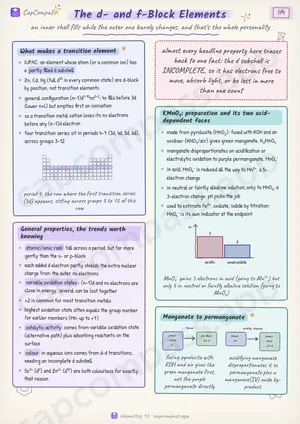
What makes a transition element
- IUPAC: an element whose atom (or a common ion) has a partly filled d subshell
- Zn, Cd, Hg (full d^10 in every common state) are d-block by position, not transition elements
- general configuration (n-1)d^1-10ns^0-2; 4s fills before 3d (lower n+l) but empties first on ionisation
- so a transition metal cation loses its ns electrons before any (n-1)d electron
- four transition series sit in periods 4-7 (3d, 4d, 5d, 6d), across groups 3-12
General properties, the trends worth knowing
- atomic/ionic radii fall across a period, but far more gently than the s- or p-block
- each added d electron partly shields the extra nuclear charge from the outer ns electrons
- variable oxidation states: (n-1)d and ns electrons are close in energy, several can be lost together
- +2 is common for most transition metals
- highest oxidation state often equals the group number for earlier members (Mn: up to +7)
- catalytic activity comes from variable oxidation state (alternative path) plus adsorbing reactants on the surface
- colour in aqueous ions comes from d-d transitions, needing an incomplete d subshell
- Sc^3+ (d^0) and Zn^2+ (d^10) are both colourless for exactly that reason
KMnO4: preparation and its two acid-dependent faces
- made from pyrolusite (MnO_2): fused with KOH and an oxidiser (KNO_3/air) gives green manganate, K_2MnO_4
- manganate disproportionates on acidification or electrolytic oxidation to purple permanganate, MnO_4^-
- in acid, MnO_4^- is reduced all the way to Mn^2+, a 5-electron change
- in neutral or faintly alkaline solution, only to MnO_2, a 3-electron change: pH picks the job
- used to estimate Fe^2+, oxalate, iodide by titration: MnO_4^- is its own indicator at the endpoint
Page 1 of 4. The full sheet, all 4 pages, opens free in the app.
What this The d- and f-Block Elements sheet covers
- What makes a transition element
- General properties, the trends worth knowing
- KMnO4: preparation and its two acid-dependent faces
- Manganate to permanganate
- K2Cr2O7: preparation and the chromate-dichromate balance
- Chromate tips over to dichromate in acid
- The f-block, at a glance
- Lanthanoids
- Actinoids
- Lanthanoid contraction, and why it matters beyond the f-block
- Actinoid contraction: bigger than the lanthanoid version
- Things to remember before the traps
- Traps that cost marks
- Tricks that save time
How CapCompass uses this sheet
These notes are not a standalone PDF. CapCompass plans Chemistry chapter by chapter against your real exam dates and free hours, and when the plan reaches The d- and f-Block Elements the sheet opens inside the study block itself — at the page covering the sub-topic that block is on, with the timer still running. Revision arrives at the moment the plan says revise, instead of having to be gone looking for.