Chemical Kinetics — Class 12 Maharashtra HSC Chemistry revision notes
A 5-page visual revision sheet for Chemical Kinetics, written for Class 12 Maharashtra HSC Chemistry. Formulas, diagrams and the traps that cost marks, laid out to be read the night before rather than the term before. Free, and it opens inside CapCompass.
 Page 1 as PDF
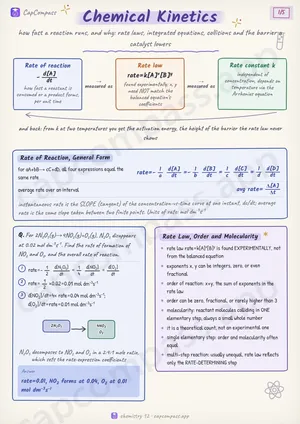
Chemical Kinetics in one look
how fast a reaction runs, and why: rate laws, integrated equations, collisions and the barrier a catalyst lowers
- Rate of reaction: how fast a reactant is consumed or a product forms, per unit time
- Rate law: found experimentally; x, y need NOT match the balanced equation's coefficients
- Rate constant k: independent of concentration, depends on temperature via the Arrhenius equation
Rate of Reaction, General Form
- for aA+bBto cC+dD, all four expressions equal the same rate
rate=-1/ad[A]/dt=-1/bd[B]/dt=1/cd[C]/dt=1/dd[D]/dt - average rate over an interval
avg rate=Δ[A]/Δ t
Q. For 2N_2O_5(g)to4NO_2(g)+O_2(g), N_2O_5 disappears at 0.02 mol dm^-3s^-1. Find the rate of formation of NO_2 and O_2, and the overall rate of reaction.
- rate=-1/2d[N_2O_5]/dt=1/4d[NO_2]/dt=d[O_2]/dt
- rate=1/2×0.02=0.01 mol dm^-3s^-1
- d[NO_2]/dt=4× rate=0.04 mol dm^-3s^-1;quad d[O_2]/dt=rate=0.01 mol dm^-3s^-1
Answer: rate=0.01, NO_2 forms at 0.04, O_2 at 0.01 mol dm^-3s^-1
Rate Law, Order and Molecularity
- rate law rate=k[A]^x[B]^y is found EXPERIMENTALLY, not from the balanced equation
- exponents x, y can be integers, zero, or even fractional
- order of reaction: x+y, the sum of exponents in the rate law
- order can be zero, fractional, or rarely higher than 3
- molecularity: reactant molecules colliding in ONE elementary step, always a small whole number
- it is a theoretical count, not an experimental one
- single elementary step: order and molecularity often equal
- multi-step reaction: usually unequal, rate law reflects only the RATE-DETERMINING step
Page 1 of 5. The full sheet, all 5 pages, opens free in the app.
What this Chemical Kinetics sheet covers
- Rate of reaction
- Rate law
- Rate constant k
- Rate of Reaction, General Form
- for aA+bBto cC+dD, all four expressions equal the same rate
- average rate over an interval
- Rate Law, Order and Molecularity
- Integrated Rate Law: First Order
- differential form
- integrated form
- exponential form
- half life, INDEPENDENT of initial concentration
- Order: half life and units of k
- Zero Order vs First Order
- Zero order
- First order
- Pseudo-First-Order Reactions
- Collision Theory of Bimolecular Reactions
- Arrhenius Equation
- temperature dependence of the rate constant
- linearised (straight line, slope -E_a/2.303R)
- two-temperature form, E_a from k_1 at T_1 and k_2 at T_2
- Catalysts: a Lower Barrier, Not a New Destination
- Traps that cost marks
- Tricks that save time
How CapCompass uses this sheet
These notes are not a standalone PDF. CapCompass plans Chemistry chapter by chapter against your real exam dates and free hours, and when the plan reaches Chemical Kinetics the sheet opens inside the study block itself — at the page covering the sub-topic that block is on, with the timer still running. Revision arrives at the moment the plan says revise, instead of having to be gone looking for.
More Chemistry Class 12 revision notes
- Alcohols, Phenols and Ethers
- Aldehydes, Ketones and Carboxylic Acids
- Amines
- Biomolecules
- Chemical Thermodynamics
- Coordination Compounds
- Electrochemistry
- Elements of Groups 16, 17 and 18
- Green Chemistry and Nanochemistry
- Halogen Derivatives
- Introduction to Polymer Chemistry
- Ionic Equilibria
- Solutions
- Transition and Inner Transition Elements