Ionic Equilibria — Class 12 Maharashtra HSC Chemistry revision notes
A 5-page visual revision sheet for Ionic Equilibria, written for Class 12 Maharashtra HSC Chemistry. Formulas, diagrams and the traps that cost marks, laid out to be read the night before rather than the term before. Free, and it opens inside CapCompass.
 Page 1 as PDF
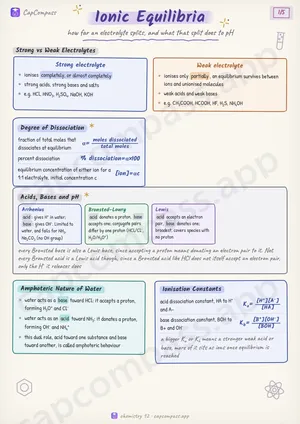
Ionic Equilibria in one look
how far an electrolyte splits, and what that split does to pH
Strong vs Weak Electrolytes
- ionises completely, or almost completely
- strong acids, strong bases and salts
- e.g. HCl, HNO_3, H_2SO_4, NaOH, KOH
- ionises only partially, an equilibrium survives between ions and unionised molecules
- weak acids and weak bases
- e.g. CH_3COOH, HCOOH, HF, H_2S, NH_4OH
Degree of Dissociation
- fraction of total moles that dissociates at equilibrium
α=fracmoles dissociatedtotal moles - percent dissociation
\% dissociation=α×100 - equilibrium concentration of either ion for a 1:1 electrolyte, initial concentration c
[ion]=α c
Acids, Bases and pH
- Arrhenius: acid: gives H^+ in water; base: gives OH^-. Limited to water, and fails for NH_3, Na_2CO_3 (no OH group)
- Bronsted-Lowry: acid donates a proton, base accepts one; conjugate pairs differ by one proton (HCl/Cl^-, H_2O/H_3O^+)
- Lewis: acid accepts an electron pair, base donates one; broadest, covers species with no proton
Amphoteric Nature of Water
- water acts as a base toward HCl: it accepts a proton, forming H_3O^+ and Cl^-
- water acts as an acid toward NH_3: it donates a proton, forming OH^- and NH_4^+
- this dual role, acid toward one substance and base toward another, is called amphoteric behaviour
Ionisation Constants
- acid dissociation constant, HA to H+ and A-
K_a=[H^+][A^-]/[HA] - base dissociation constant, BOH to B+ and OH-
K_b=[B^+][OH^-]/[BOH]
Page 1 of 5. The full sheet, all 5 pages, opens free in the app.
What this Ionic Equilibria sheet covers
- Strong vs Weak Electrolytes
- Strong electrolyte
- Weak electrolyte
- Degree of Dissociation
- fraction of total moles that dissociates at equilibrium
- percent dissociation
- equilibrium concentration of either ion for a 1:1 electrolyte, initial concentration c
- Acids, Bases and pH
- Arrhenius
- Bronsted-Lowry
- Lewis
- Amphoteric Nature of Water
- Ionisation Constants
- acid dissociation constant, HA to H+ and A-
- base dissociation constant, BOH to B+ and OH-
- Ostwald's Dilution Law
- exact form, weak acid, initial concentration c
- for a weak acid α is small, so 1-α ≈ 1
- degree of dissociation follows
- the same relations hold for a weak base, with K_b
- pH: which formula applies
- pH of a weak acid from Ka
- Autoionization of Water and Kw
- self ionisation of water
- ionic product of water
- at 298 K
- pH and pOH
- pH
- pOH
- relationship, from K_w at 298 K
- Acidity, Basicity and Neutrality
- Hydrolysis of Salts
- Types of Salt Hydrolysis
- Strong acid, strong base
- Strong acid, weak base
- Weak acid, strong base
- Weak acid, weak base
- Buffer Solutions
- Henderson-Hasselbalch Equation
- pH of an acidic buffer
- pOH of a basic buffer
- the p-scale definitions used above
- Buffer Action, Properties and Applications
- Strong acid-strong base titration
- Solubility Product
- general sparingly soluble salt
- in terms of molar solubility S
- Condition of Precipitation
- Common Ion Effect
- Traps that cost marks
- Tricks that save time
How CapCompass uses this sheet
These notes are not a standalone PDF. CapCompass plans Chemistry chapter by chapter against your real exam dates and free hours, and when the plan reaches Ionic Equilibria the sheet opens inside the study block itself — at the page covering the sub-topic that block is on, with the timer still running. Revision arrives at the moment the plan says revise, instead of having to be gone looking for.
More Chemistry Class 12 revision notes
- Alcohols, Phenols and Ethers
- Aldehydes, Ketones and Carboxylic Acids
- Amines
- Biomolecules
- Chemical Kinetics
- Chemical Thermodynamics
- Coordination Compounds
- Electrochemistry
- Elements of Groups 16, 17 and 18
- Green Chemistry and Nanochemistry
- Halogen Derivatives
- Introduction to Polymer Chemistry
- Solutions
- Transition and Inner Transition Elements