Elements of Groups 16, 17 and 18 — Class 12 Maharashtra HSC Chemistry revision notes
A 6-page visual revision sheet for Elements of Groups 16, 17 and 18, written for Class 12 Maharashtra HSC Chemistry. Formulas, diagrams and the traps that cost marks, laid out to be read the night before rather than the term before. Free, and it opens inside CapCompass.
 Page 1 as PDF
Elements of Groups 16, 17 and 18 in one look
chalcogens, halogens and noble gases: three families that go from reactive to unreactive across one row
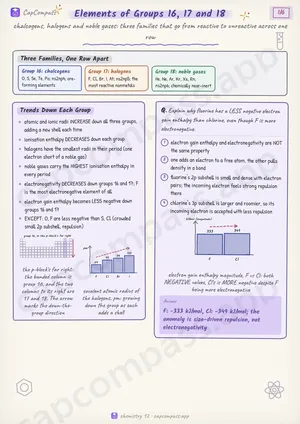
Three Families, One Row Apart
- Group 16: chalcogens: O, S, Se, Te, Po; ns2np4; ore-forming elements
- Group 17: halogens: F, Cl, Br, I, At; ns2np5; the most reactive nonmetals
- Group 18: noble gases: He, Ne, Ar, Kr, Xe, Rn; ns2np6; chemically near-inert
Trends Down Each Group
- atomic and ionic radii INCREASE down all three groups, adding a new shell each time
- ionisation enthalpy DECREASES down each group
- halogens have the smallest radii in their period (one electron short of a noble gas)
- noble gases carry the HIGHEST ionisation enthalpy in every period
- electronegativity DECREASES down groups 16 and 17; F is the most electronegative element of all
- electron gain enthalpy becomes LESS negative down groups 16 and 17
- EXCEPT: O, F are less negative than S, Cl (crowded small 2p subshell, repulsion)
Q. Explain why fluorine has a LESS negative electron gain enthalpy than chlorine, even though F is more electronegative.
- electron gain enthalpy and electronegativity are NOT the same property
- one adds an electron to a free atom, the other pulls density in a bond
- fluorine's 2p subshell is small and dense with electron pairs; the incoming electron feels strong repulsion there
- chlorine's 3p subshell is larger and roomier, so its incoming electron is accepted with less repulsion
Answer: F: -333 kJ/mol, Cl: -349 kJ/mol; the anomaly is size-driven repulsion, not electronegativity
Page 1 of 6. The full sheet, all 6 pages, opens free in the app.
What this Elements of Groups 16, 17 and 18 sheet covers
- Three Families, One Row Apart
- Group 16: chalcogens
- Group 17: halogens
- Group 18: noble gases
- Trends Down Each Group
- Oxygen's Anomalous Behaviour
- Oxygen (unlike S, Se, Te)
- Why oxygen and fluorine differ
- Oxidation State Limits Across the Three Groups
- Allotropy
- Oxoacids of Sulfur and Halogens
- sulfurous acid
- sulfuric acid
- pyrosulfuric acid (oleum)
- thiosulfuric acid
- Halogen Oxoacid Families
- Sulfur Dioxide and Sulfuric Acid
- Chlorine and Hydrogen Chloride
- Ozone: Preparation, Structure, Reactivity
- Acidic, Basic, Amphoteric, Neutral Oxides
- Acidic / Basic
- Amphoteric / Neutral
- Interhalogen Compounds
- Xenon Compounds
- Symbols and Key Names
- Traps that cost marks
- Tricks that save time
How CapCompass uses this sheet
These notes are not a standalone PDF. CapCompass plans Chemistry chapter by chapter against your real exam dates and free hours, and when the plan reaches Elements of Groups 16, 17 and 18 the sheet opens inside the study block itself — at the page covering the sub-topic that block is on, with the timer still running. Revision arrives at the moment the plan says revise, instead of having to be gone looking for.
More Chemistry Class 12 revision notes
- Alcohols, Phenols and Ethers
- Aldehydes, Ketones and Carboxylic Acids
- Amines
- Biomolecules
- Chemical Kinetics
- Chemical Thermodynamics
- Coordination Compounds
- Electrochemistry
- Green Chemistry and Nanochemistry
- Halogen Derivatives
- Introduction to Polymer Chemistry
- Ionic Equilibria
- Solutions
- Transition and Inner Transition Elements