Transition and Inner Transition Elements — Class 12 Maharashtra HSC Chemistry revision notes
A 7-page visual revision sheet for Transition and Inner Transition Elements, written for Class 12 Maharashtra HSC Chemistry. Formulas, diagrams and the traps that cost marks, laid out to be read the night before rather than the term before. Free, and it opens inside CapCompass.
 Page 1 as PDF
Transition and Inner Transition Elements in one look
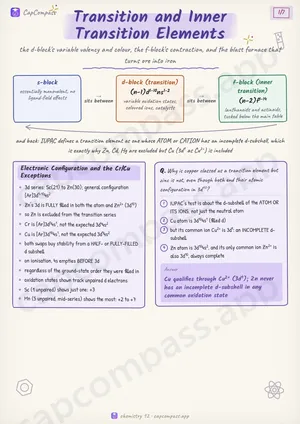
the d-block's variable valency and colour, the f-block's contraction, and the blast furnace that turns ore into iron
- s-block: essentially monovalent, no ligand-field effects
- d-block (transition): variable oxidation states, coloured ions, catalysts
- f-block (inner transition): lanthanoids and actinoids, tucked below the main table
Electronic Configuration and the Cr/Cu Exceptions
- 3d series: Sc(21) to Zn(30); general configuration [Ar]3d^1-104s^2
- Zn's 3d is FULLY filled in both the atom and Zn^2+ (3d^10)
- so Zn is excluded from the transition series
- Cr is [Ar]3d^54s^1, not the expected 3d^44s^2
- Cu is [Ar]3d^104s^1, not the expected 3d^94s^2
- both swaps buy stability from a HALF- or FULLY-FILLED d subshell
- on ionisation, 4s empties BEFORE 3d
- regardless of the ground-state order they were filled in
- oxidation states shown track unpaired d electrons
- Sc (1 unpaired) shows just one: +3
- Mn (5 unpaired, mid-series) shows the most: +2 to +7
Q. Why is copper classed as a transition element but zinc is not, even though both end their atomic configuration in 3d^10?
- IUPAC's test is about the d-subshell of the ATOM OR ITS IONS, not just the neutral atom
- Cu atom is 3d^104s^1 (filled d)
- but its common ion Cu^2+ is 3d^9: an INCOMPLETE d-subshell
- Zn atom is 3d^104s^2, and its only common ion Zn^2+ is also 3d^10, always complete
Answer: Cu qualifies through Cu^2+ (3d^9); Zn never has an incomplete d-subshell in any common oxidation state
Page 1 of 7. The full sheet, all 7 pages, opens free in the app.
What this Transition and Inner Transition Elements sheet covers
- s-block
- d-block (transition)
- f-block (inner transition)
- Electronic Configuration and the Cr/Cu Exceptions
- Trends in Atomic Properties
- Magnetic Moment (Spin-Only)
- spin-only formula, n = number of unpaired electrons, μ in Bohr Magneton
- Colour and Catalytic Activity
- Interstitial Compounds vs Alloys
- Interstitial compounds
- Alloys
- KMnO4 and K2Cr2O7: Preparation
- KMnO4 and K2Cr2O7 as Oxidisers
- KMnO_4 in acid, oxidises I^- to I_2
- KMnO_4 in acid, oxidises Fe^2+ to Fe^3+
- K_2Cr_2O_7 in acid, oxidises I^- to I_2
- Extraction of Iron: the Blast Furnace
- Reactions in the Blast Furnace, by Zone
- combustion zone (~2000 K, near tuyeres): coke burns to CO, strongly exothermic
- reduction zone (~900 K): Fe2O3 reduced mainly by CO
- slag formation: limestone decomposes, then CaO scavenges the silica gangue
- f-Block: Lanthanoids and Actinoids
- Lanthanoids vs Actinoids
- Lanthanoids
- Actinoids
- Symbols
- Traps that cost marks
- Tricks that save time
How CapCompass uses this sheet
These notes are not a standalone PDF. CapCompass plans Chemistry chapter by chapter against your real exam dates and free hours, and when the plan reaches Transition and Inner Transition Elements the sheet opens inside the study block itself — at the page covering the sub-topic that block is on, with the timer still running. Revision arrives at the moment the plan says revise, instead of having to be gone looking for.
More Chemistry Class 12 revision notes
- Alcohols, Phenols and Ethers
- Aldehydes, Ketones and Carboxylic Acids
- Amines
- Biomolecules
- Chemical Kinetics
- Chemical Thermodynamics
- Coordination Compounds
- Electrochemistry
- Elements of Groups 16, 17 and 18
- Green Chemistry and Nanochemistry
- Halogen Derivatives
- Introduction to Polymer Chemistry
- Ionic Equilibria
- Solutions