Halogen Derivatives — Class 12 Maharashtra HSC Chemistry revision notes
A 7-page visual revision sheet for Halogen Derivatives, written for Class 12 Maharashtra HSC Chemistry. Formulas, diagrams and the traps that cost marks, laid out to be read the night before rather than the term before. Free, and it opens inside CapCompass.
 Page 1 as PDF
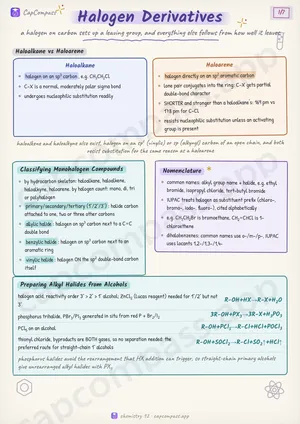
Halogen Derivatives in one look
a halogen on carbon sets up a leaving group, and everything else follows from how well it leaves
Haloalkane vs Haloarene
- halogen on an sp^3 carbon, e.g. CH_3CH_2Cl
- C-X is a normal, moderately polar sigma bond
- undergoes nucleophilic substitution readily
- halogen directly on an sp^2 aromatic carbon
- lone pair conjugates into the ring: C-X gets partial double-bond character
- SHORTER and stronger than a haloalkane's: 169 pm vs 178 pm for C-Cl
- resists nucleophilic substitution unless an activating group is present
Classifying Monohalogen Compounds
- by hydrocarbon skeleton: haloalkane, haloalkene, haloalkyne, haloarene. by halogen count: mono, di, tri or polyhalogen
- primary/secondary/tertiary (1 deg/2 deg/3 deg): halide carbon attached to one, two or three other carbons
- allylic halide: halogen on sp^3 carbon next to a C=C double bond
- benzylic halide: halogen on sp^3 carbon next to an aromatic ring
- vinylic halide: halogen ON the sp^2 double-bond carbon itself
Nomenclature
- common names: alkyl group name + halide, e.g. ethyl bromide, isopropyl chloride, tert-butyl bromide
- IUPAC treats halogen as substituent prefix (chloro-, bromo-, iodo-, fluoro-), cited alphabetically
- e.g. CH_3CH_2Br is bromoethane, CH_2=CHCl is 1-chloroethene
- dihalobenzenes: common names use o-/m-/p-, IUPAC uses locants 1,2-/1,3-/1,4-
Preparing Alkyl Halides from Alcohols
- halogen acid, reactivity order 3 deg > 2 deg > 1 deg alcohol; ZnCl_2 (Lucas reagent) needed for 1 deg/2 deg but not 3 deg
R-OH+HXto R-X+H_2O - phosphorus trihalide, PBr_3/PI_3 generated in situ from red P + Br_2/I_2
3R-OH+PX_3to3R-X+H_3PO_3 - PCl_5 on an alcohol
R-OH+PCl_5to R-Cl+HCl+POCl_3 - thionyl chloride, byproducts are BOTH gases, so no separation needed: the preferred route for straight-chain 1 deg alcohols
R-OH+SOCl_2to R-Cl+SO_2↑+HCl↑
Page 1 of 7. The full sheet, all 7 pages, opens free in the app.
What this Halogen Derivatives sheet covers
- Haloalkane vs Haloarene
- Haloalkane
- Haloarene
- Classifying Monohalogen Compounds
- Nomenclature
- Preparing Alkyl Halides from Alcohols
- halogen acid, reactivity order 3 deg > 2 deg > 1 deg alcohol; ZnCl_2 (Lucas reagent) needed for 1 deg/2 deg but not 3 deg
- phosphorus trihalide, PBr_3/PI_3 generated in situ from red P + Br_2/I_2
- PCl_5 on an alcohol
- thionyl chloride, byproducts are BOTH gases, so no separation needed: the preferred route for straight-chain 1 deg alcohols
- Which route wins for R-OH to R-X
- Other Preparation Routes
- Physical Properties
- Chirality and Optical Isomerism
- Finding a chiral carbon
- SN1 vs SN2 Mechanism
- SN1
- SN2
- SN1 solvolysis of a 3 deg halide
- Ambident Nucleophiles
- Factors Deciding SN1/SN2
- Reaction with Active Metals
- Reactions of Haloarenes
- Uses and Environmental Effects of Polyhalogen Compounds
- Ozone Depletion by CFCs
- UV light breaks the weakest bond in the CFC
- the chlorine atom destroys ozone catalytically, then regenerates
- Traps that cost marks
- Tricks that save time
How CapCompass uses this sheet
These notes are not a standalone PDF. CapCompass plans Chemistry chapter by chapter against your real exam dates and free hours, and when the plan reaches Halogen Derivatives the sheet opens inside the study block itself — at the page covering the sub-topic that block is on, with the timer still running. Revision arrives at the moment the plan says revise, instead of having to be gone looking for.
More Chemistry Class 12 revision notes
- Alcohols, Phenols and Ethers
- Aldehydes, Ketones and Carboxylic Acids
- Amines
- Biomolecules
- Chemical Kinetics
- Chemical Thermodynamics
- Coordination Compounds
- Electrochemistry
- Elements of Groups 16, 17 and 18
- Green Chemistry and Nanochemistry
- Introduction to Polymer Chemistry
- Ionic Equilibria
- Solutions
- Transition and Inner Transition Elements