Chemical Thermodynamics — Class 12 Maharashtra HSC Chemistry revision notes
A 6-page visual revision sheet for Chemical Thermodynamics, written for Class 12 Maharashtra HSC Chemistry. Formulas, diagrams and the traps that cost marks, laid out to be read the night before rather than the term before. Free, and it opens inside CapCompass.
 Page 1 as PDF
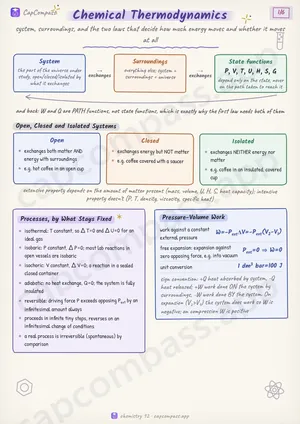
Chemical Thermodynamics in one look
system, surroundings, and the two laws that decide how much energy moves and whether it moves at all
- System: the part of the universe under study, open/closed/isolated by what it exchanges
- Surroundings: everything else; system + surroundings = universe
- State functions: depend only on the state, never on the path taken to reach it
Open, Closed and Isolated Systems
- exchanges both matter AND energy with surroundings
- e.g. hot coffee in an open cup
- exchanges energy but NOT matter
- e.g. coffee covered with a saucer
- exchanges NEITHER energy nor matter
- e.g. coffee in an insulated, covered cup
Processes, by What Stays Fixed
- isothermal: T constant, so Δ T=0 and Δ U=0 for an ideal gas
- isobaric: P constant, Δ P=0; most lab reactions in open vessels are isobaric
- isochoric: V constant, Δ V=0; a reaction in a sealed closed container
- adiabatic: no heat exchange, Q=0; the system is fully insulated
- reversible: driving force P exceeds opposing P_ext by an infinitesimal amount always
- proceeds in infinite tiny steps, reverses on an infinitesimal change of conditions
- a real process is irreversible (spontaneous) by comparison
Pressure-Volume Work
- work against a constant external pressure
W=-P_extΔ V=-P_ext(V_2-V_1) - free expansion: expansion against zero opposing force, e.g. into vacuum
P_ext=0 ⇒ W=0 - unit conversion
1 dm^3 bar=100 J
Page 1 of 6. The full sheet, all 6 pages, opens free in the app.
What this Chemical Thermodynamics sheet covers
- System
- Surroundings
- State functions
- Open, Closed and Isolated Systems
- Open
- Closed
- Isolated
- Processes, by What Stays Fixed
- work done during expansion or compression
- Pressure-Volume Work
- work against a constant external pressure
- free expansion: expansion against zero opposing force, e.g. into vacuum
- unit conversion
- Maximum Work is Reversible Work
- First Law and Internal Energy
- first law: energy of system + surroundings is conserved
- isothermal (ideal gas): Δ U=0
- adiabatic: Q=0
- isochoric: Δ V=0
- Enthalpy
- definition
- at constant pressure, this reduces to
- for gas-phase reactions, using PV=nRT
- work done in a chemical reaction, at constant T and P
- Enthalpies of Physical and Atomic Change
- Thermochemistry: Standard States and Named Enthalpies
- ΔrH° from Formation and Bond Enthalpies
- from standard enthalpies of formation
- from bond enthalpies: bonds BROKEN in reactants minus bonds FORMED in products
- Hess's Law of Constant Heat Summation
- the enthalpy change for a reaction is the SUM of the enthalpy changes of any set of steps that add up to it
- Spontaneity, Entropy and the Second Law
- Gibbs Energy: the System-Only Spontaneity Test
- at constant T, P
- link to total entropy (surroundings' entropy folded in via Δ S_surr=-Δ H/T)
- temperature of changeover between spontaneous and nonspontaneous
- Work and spontaneity: special cases
- Gibbs Energy and the Equilibrium Constant
- Gibbs energy away from standard state, Q the reaction quotient
- at equilibrium, Δ G=0 and Qto K
- Traps that cost marks
- Tricks that save time
How CapCompass uses this sheet
These notes are not a standalone PDF. CapCompass plans Chemistry chapter by chapter against your real exam dates and free hours, and when the plan reaches Chemical Thermodynamics the sheet opens inside the study block itself — at the page covering the sub-topic that block is on, with the timer still running. Revision arrives at the moment the plan says revise, instead of having to be gone looking for.
More Chemistry Class 12 revision notes
- Alcohols, Phenols and Ethers
- Aldehydes, Ketones and Carboxylic Acids
- Amines
- Biomolecules
- Chemical Kinetics
- Coordination Compounds
- Electrochemistry
- Elements of Groups 16, 17 and 18
- Green Chemistry and Nanochemistry
- Halogen Derivatives
- Introduction to Polymer Chemistry
- Ionic Equilibria
- Solutions
- Transition and Inner Transition Elements