Coordination Compounds — Class 12 Maharashtra HSC Chemistry revision notes
A 7-page visual revision sheet for Coordination Compounds, written for Class 12 Maharashtra HSC Chemistry. Formulas, diagrams and the traps that cost marks, laid out to be read the night before rather than the term before. Free, and it opens inside CapCompass.
 Page 1 as PDF
Coordination Compounds in one look
a metal in the middle, ligands donating a pair each, and one number that fixes the shape
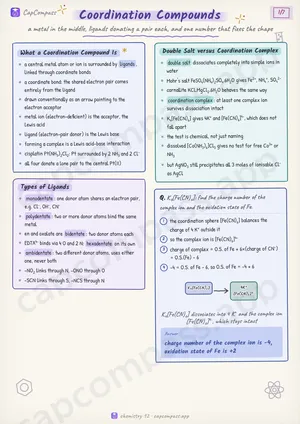
What a Coordination Compound Is
- a central metal atom or ion is surrounded by ligands, linked through coordinate bonds
- a coordinate bond: the shared electron pair comes entirely from the ligand
- drawn conventionally as an arrow pointing to the electron acceptor
- metal ion (electron-deficient) is the acceptor, the Lewis acid
- ligand (electron-pair donor) is the Lewis base
- forming a complex is a Lewis acid-base interaction
- cisplatin Pt(NH_3)_2Cl_2: Pt surrounded by 2 NH_3 and 2 Cl^-
- all four donate a lone pair to the central Pt(II)
Types of Ligands
- monodentate: one donor atom shares an electron pair, e.g. Cl^-, OH^-, CN^-
- polydentate: two or more donor atoms bind the same metal
- en and oxalate are bidentate: two donor atoms each
- EDTA^4- binds via 4 O and 2 N: hexadentate on its own
- ambidentate: two different donor atoms, uses either one, never both
- -NO_2 links through N, -ONO through O
- -SCN links through S, -NCS through N
Double Salt versus Coordination Complex
- double salt dissociates completely into simple ions in water
- Mohr's salt FeSO_4(NH_4)_2SO_4.6H_2O gives Fe^2+, NH_4^+, SO_4^2-
- carnallite KCl.MgCl_2.6H_2O behaves the same way
- coordination complex: at least one complex ion survives dissociation intact
- K_4[Fe(CN)_6] gives 4K^+ and [Fe(CN)_6]^4-, which does not fall apart
- the test is chemical, not just naming
- dissolved [Co(NH_3)_6]Cl_3 gives no test for free Co^3+ or NH_3
- but AgNO_3 still precipitates all 3 moles of ionisable Cl^- as AgCl
Q. K_4[Fe(CN)_6]: find the charge number of the complex ion and the oxidation state of Fe.
- the coordination sphere [Fe(CN)_6] balances the charge of 4 K^+ outside it
- so the complex ion is [Fe(CN)_6]^4-
- charge of complex = O.S. of Fe + 6×(charge of CN^-) = O.S.(Fe) - 6
- -4 = O.S. of Fe - 6, so O.S. of Fe = -4 + 6
Answer: charge number of the complex ion is -4, oxidation state of Fe is +2
Page 1 of 7. The full sheet, all 7 pages, opens free in the app.
What this Coordination Compounds sheet covers
- What a Coordination Compound Is
- Types of Ligands
- Double Salt versus Coordination Complex
- Terms and Classification
- IUPAC Nomenclature, the Rules in Order
- total electron count around the metal centre
- Effective Atomic Number (EAN) Rule
- EAN equals electrons on the metal ion plus electrons donated by all ligands
- Z: atomic number of the metal. X: electrons lost by the metal to form the ion. Y: electrons donated by the ligands
- Homoleptic/Heteroleptic and Charge-Type, One More Pass
- Structural isomers: same formula, different bonding
- Stereoisomers: same bonds, different arrangement
- Geometric Isomers (Diastereomers)
- Optical Isomers (Enantiomers)
- thermodynamic stability of a complex
- Stability Constant
- equilibrium: M^a+ + nL^x- rightleftharpoons [ML_n]^a+-nx
- What Governs Stability
- Valence Bond Theory: the Steps
- Tetrahedral vs Square Planar, Both C.N. 4
- Tetrahedral, e.g. [NiCl4]2-
- Square planar, e.g. [Ni(CN)4]2-
- Limits of VBT
- Crystal Field Theory, Octahedral Field
- Spectrochemical Series and Spin
- Tetrahedral Field and Colour
- Applications
- Traps that cost marks
- Tricks that save time
How CapCompass uses this sheet
These notes are not a standalone PDF. CapCompass plans Chemistry chapter by chapter against your real exam dates and free hours, and when the plan reaches Coordination Compounds the sheet opens inside the study block itself — at the page covering the sub-topic that block is on, with the timer still running. Revision arrives at the moment the plan says revise, instead of having to be gone looking for.
More Chemistry Class 12 revision notes
- Alcohols, Phenols and Ethers
- Aldehydes, Ketones and Carboxylic Acids
- Amines
- Biomolecules
- Chemical Kinetics
- Chemical Thermodynamics
- Electrochemistry
- Elements of Groups 16, 17 and 18
- Green Chemistry and Nanochemistry
- Halogen Derivatives
- Introduction to Polymer Chemistry
- Ionic Equilibria
- Solutions
- Transition and Inner Transition Elements