Introduction to Polymer Chemistry — Class 12 Maharashtra HSC Chemistry revision notes
A 7-page visual revision sheet for Introduction to Polymer Chemistry, written for Class 12 Maharashtra HSC Chemistry. Formulas, diagrams and the traps that cost marks, laid out to be read the night before rather than the term before. Free, and it opens inside CapCompass.
 Page 1 as PDF
Introduction to Polymer Chemistry in one look
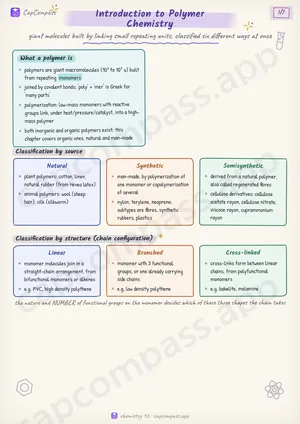
giant molecules built by linking small repeating units, classified six different ways at once
What a polymer is
- polymers are giant macromolecules (10^3 to 10^7 u) built from repeating monomers
- joined by covalent bonds; 'poly' + 'mer' is Greek for 'many parts'
- polymerization: low-mass monomers with reactive groups link, under heat/pressure/catalyst, into a high-mass polymer
- both inorganic and organic polymers exist; this chapter covers organic ones, natural and man-made
Classification by source
- plant polymers: cotton, linen, natural rubber (from Hevea latex)
- animal polymers: wool (sheep hair), silk (silkworm)
- man-made, by polymerization of one monomer or copolymerization of several
- nylon, terylene, neoprene; subtypes are fibres, synthetic rubbers, plastics
- derived from a natural polymer, also called regenerated fibres
- cellulose derivatives: cellulose acetate rayon, cellulose nitrate, viscose rayon, cuprammonium rayon
Classification by structure (chain configuration)
- monomer molecules join in a straight-chain arrangement, from bifunctional monomers or alkenes
- e.g. PVC, high density polythene
- monomer with 3 functional groups, or one already carrying side chains
- e.g. low density polythene
- cross-links form between linear chains, from polyfunctional monomers
- e.g. bakelite, melamine
Page 1 of 7. The full sheet, all 7 pages, opens free in the app.
What this Introduction to Polymer Chemistry sheet covers
- What a polymer is
- Classification by source
- Natural
- Synthetic
- Semisynthetic
- Classification by structure (chain configuration)
- Linear
- Branched
- Cross-linked
- Classification by mode of polymerization
- Addition (chain growth)
- Condensation (step growth)
- Ring opening
- Free radical addition mechanism, three steps
- initiation: an initiator (benzoyl peroxide, acetyl peroxide) generates a free radical
- propagation: the radical adds across a vinyl monomer's C=C, and repeats rapidly
- termination: two growing chain radicals combine
- Classification by intermolecular forces
- Elastomers
- Fibres
- Thermoplastic
- Thermosetting
- Homopolymer vs copolymer, and biodegradability
- Natural rubber and vulcanization
- Low vs high density polythene
- LDP
- HDP
- Teflon and polyacrylonitrile
- Teflon: tetrafluoroethylene, peroxide initiator, high pressure
- polyacrylonitrile: peroxide initiator
- Polyamides: nylon 6,6 and nylon 6
- nylon 6,6: condensation of adipic acid + hexamethylenediamine, via the 'nylon salt', 553 K, high pressure
- nylon 6: ring-opening polymerization of epsilon-caprolactam
- Polyesters: terylene / PET
- terylene (dacron): ethylene glycol + terephthalic acid, catalyst, 420-460 K
- Phenol-formaldehyde (bakelite) and melamine-formaldehyde
- Synthetic rubbers: Buna-S, Buna-N, neoprene
- Viscose rayon: a semisynthetic fibre
- Molecular mass and degree of polymerization
- Biodegradable polymers
- A few more commercial polymers
- PVC
- Perspex
- Polycarbonate
- Glyptal
- Urea-formaldehyde
- Polyacrylamide
- Symbols
- Traps that cost marks
- Tricks that save time
How CapCompass uses this sheet
These notes are not a standalone PDF. CapCompass plans Chemistry chapter by chapter against your real exam dates and free hours, and when the plan reaches Introduction to Polymer Chemistry the sheet opens inside the study block itself — at the page covering the sub-topic that block is on, with the timer still running. Revision arrives at the moment the plan says revise, instead of having to be gone looking for.
More Chemistry Class 12 revision notes
- Alcohols, Phenols and Ethers
- Aldehydes, Ketones and Carboxylic Acids
- Amines
- Biomolecules
- Chemical Kinetics
- Chemical Thermodynamics
- Coordination Compounds
- Electrochemistry
- Elements of Groups 16, 17 and 18
- Green Chemistry and Nanochemistry
- Halogen Derivatives
- Ionic Equilibria
- Solutions
- Transition and Inner Transition Elements