Animal Classification — Class 10 Maharashtra SSC Science revision notes
A 3-page visual revision sheet for Animal Classification, written for Class 10 Maharashtra SSC Science. Formulas, diagrams and the traps that cost marks, laid out to be read the night before rather than the term before. Free, and it opens inside CapCompass.
 Page 1 as PDF
Animal Classification in one look
sorting the animal kingdom by body plan, and the characters that place a new animal
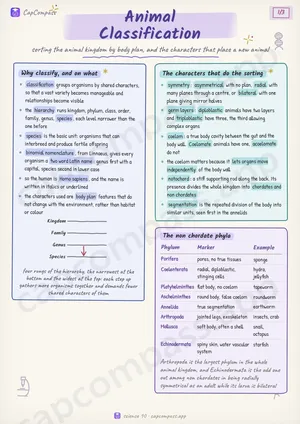
Why classify, and on what
- classification groups organisms by shared characters, so that a vast variety becomes manageable and relationships become visible
- the hierarchy runs kingdom, phylum, class, order, family, genus, species, each level narrower than the one before
- species is the basic unit: organisms that can interbreed and produce fertile offspring
- binomial nomenclature, from Linnaeus, gives every organism a two word Latin name: genus first with a capital, species second in lower case
- so the human is Homo sapiens, and the name is written in italics or underlined
- the characters used are body plan features that do not change with the environment, rather than habitat or colour
The characters that do the sorting
- symmetry: asymmetrical with no plan, radial with many planes through a centre, or bilateral with one plane giving mirror halves
- germ layers: diploblastic animals have two layers and triploblastic have three, the third allowing complex organs
- coelom: a true body cavity between the gut and the body wall. Coelomate animals have one, acoelomate do not
- the coelom matters because it lets organs move independently of the body wall
- notochord: a stiff supporting rod along the back. Its presence divides the whole kingdom into chordates and non chordates
- segmentation is the repeated division of the body into similar units, seen first in the annelids
The non chordate phyla
| Phylum | Marker | Example |
|---|---|---|
| Porifera | pores, no true tissues | sponge |
| Coelenterata | radial, diploblastic, stinging cells | hydra, jellyfish |
| Platyhelminthes | flat body, no coelom | tapeworm |
| Aschelminthes | round body, false coelom | roundworm |
| Annelida | true segmentation | earthworm |
| Arthropoda | jointed legs, exoskeleton | insects, crab |
| Mollusca | soft body, often a shell | snail, octopus |
| Echinodermata | spiny skin, water vascular system | starfish |
Page 1 of 3. The full sheet, all 3 pages, opens free in the app.
What this Animal Classification sheet covers
- Classification
- Taxonomy
- Binomial nomenclature
- Why classify, and on what
- Symmetry
- Germ layers
- Coelom
- Notochord
- The characters that do the sorting
- The non chordate phyla
- Chordata
- Vertebrata
- The chordates
- The five vertebrate classes
- Placing an unfamiliar animal
- Reading the characters in order
- Terms in this chapter
- Traps that cost marks
- Tricks that save time
How CapCompass uses this sheet
These notes are not a standalone PDF. CapCompass plans Science chapter by chapter against your real exam dates and free hours, and when the plan reaches Animal Classification the sheet opens inside the study block itself — at the page covering the sub-topic that block is on, with the timer still running. Revision arrives at the moment the plan says revise, instead of having to be gone looking for.
More Science Class 10 revision notes
- Carbon Compounds
- Cell Biology and Biotechnology
- Disaster Management
- Effects of Electric Current
- Environmental Management
- Gravitation
- Heat
- Heredity and Evolution
- Introduction to Microbiology
- Lenses
- Life Processes in Living Organisms Part 1
- Life Processes in Living Organisms Part 2
- Metallurgy
- Periodic Classification of Elements
- Refraction of Light
- Social Health
- Space Missions
- Towards Green Energy