Carbon Compounds — Class 10 Maharashtra SSC Science revision notes
A 4-page visual revision sheet for Carbon Compounds, written for Class 10 Maharashtra SSC Science. Formulas, diagrams and the traps that cost marks, laid out to be read the night before rather than the term before. Free, and it opens inside CapCompass.
 Page 1 as PDF
Carbon Compounds in one look
catenation and tetravalency, the homologous series, and the groups that decide the chemistry
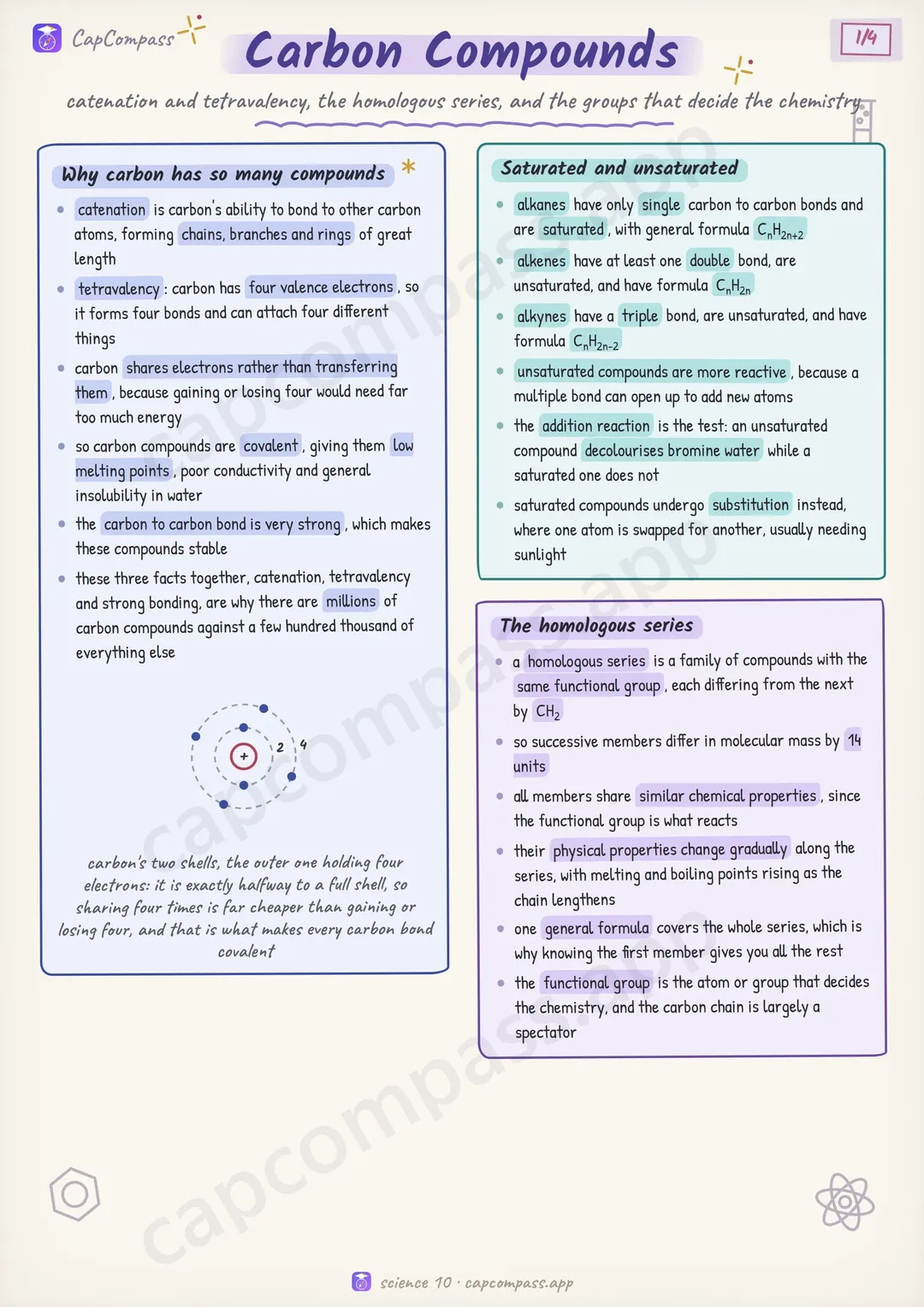
Why carbon has so many compounds
- catenation is carbon's ability to bond to other carbon atoms, forming chains, branches and rings of great length
- tetravalency: carbon has four valence electrons, so it forms four bonds and can attach four different things
- carbon shares electrons rather than transferring them, because gaining or losing four would need far too much energy
- so carbon compounds are covalent, giving them low melting points, poor conductivity and general insolubility in water
- the carbon to carbon bond is very strong, which makes these compounds stable
- these three facts together, catenation, tetravalency and strong bonding, are why there are millions of carbon compounds against a few hundred thousand of everything else
Saturated and unsaturated
- alkanes have only single carbon to carbon bonds and are saturated, with general formula C_nH_2n+2
- alkenes have at least one double bond, are unsaturated, and have formula C_nH_2n
- alkynes have a triple bond, are unsaturated, and have formula C_nH_2n-2
- unsaturated compounds are more reactive, because a multiple bond can open up to add new atoms
- the addition reaction is the test: an unsaturated compound decolourises bromine water while a saturated one does not
- saturated compounds undergo substitution instead, where one atom is swapped for another, usually needing sunlight
The homologous series
- a homologous series is a family of compounds with the same functional group, each differing from the next by CH_2
- so successive members differ in molecular mass by 14 units
- all members share similar chemical properties, since the functional group is what reacts
- their physical properties change gradually along the series, with melting and boiling points rising as the chain lengthens
- one general formula covers the whole series, which is why knowing the first member gives you all the rest
- the functional group is the atom or group that decides the chemistry, and the carbon chain is largely a spectator
Page 1 of 4. The full sheet, all 4 pages, opens free in the app.
What this Carbon Compounds sheet covers
- Catenation
- Tetravalency
- Covalent bond
- Why carbon has so many compounds
- Alkane alkene alkyne
- Saturated and unsaturated compounds
- Saturated and unsaturated
- Homologous series
- Functional group
- The homologous series
- The functional groups to know
- Naming a compound
- Ethanol
- Ethanoic acid
- Esterification
- Ethanol and ethanoic acid
- Distinguishing the two
- Soap
- Saponification
- Micelle
- Soap, and why it cleans
- Terms in this chapter
- Traps that cost marks
- Tricks that save time
How CapCompass uses this sheet
These notes are not a standalone PDF. CapCompass plans Science chapter by chapter against your real exam dates and free hours, and when the plan reaches Carbon Compounds the sheet opens inside the study block itself — at the page covering the sub-topic that block is on, with the timer still running. Revision arrives at the moment the plan says revise, instead of having to be gone looking for.
More Science Class 10 revision notes
- Animal Classification
- Cell Biology and Biotechnology
- Disaster Management
- Effects of Electric Current
- Environmental Management
- Gravitation
- Heat
- Heredity and Evolution
- Introduction to Microbiology
- Lenses
- Life Processes in Living Organisms Part 1
- Life Processes in Living Organisms Part 2
- Metallurgy
- Periodic Classification of Elements
- Refraction of Light
- Social Health
- Space Missions
- Towards Green Energy