Metallurgy — Class 10 Maharashtra SSC Science revision notes
A 4-page visual revision sheet for Metallurgy, written for Class 10 Maharashtra SSC Science. Formulas, diagrams and the traps that cost marks, laid out to be read the night before rather than the term before. Free, and it opens inside CapCompass.
 Page 1 as PDF
Metallurgy in one look
the reactivity series deciding how a metal is won from its ore, and how it is kept once won
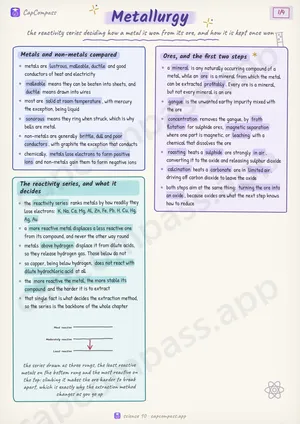
Metals and non-metals compared
- metals are lustrous, malleable, ductile and good conductors of heat and electricity
- malleable means they can be beaten into sheets, and ductile means drawn into wires
- most are solid at room temperature, with mercury the exception, being liquid
- sonorous means they ring when struck, which is why bells are metal
- non-metals are generally brittle, dull and poor conductors, with graphite the exception that conducts
- chemically, metals lose electrons to form positive ions and non-metals gain them to form negative ions
The reactivity series, and what it decides
- the reactivity series ranks metals by how readily they lose electrons: K, Na, Ca, Mg, Al, Zn, Fe, Pb, H, Cu, Hg, Ag, Au
- a more reactive metal displaces a less reactive one from its compound, and never the other way round
- metals above hydrogen displace it from dilute acids, so they release hydrogen gas. Those below do not
- so copper, being below hydrogen, does not react with dilute hydrochloric acid at all
- the more reactive the metal, the more stable its compound and the harder it is to extract
- that single fact is what decides the extraction method, so the series is the backbone of the whole chapter
Ores, and the first two steps
- a mineral is any naturally occurring compound of a metal, while an ore is a mineral from which the metal can be extracted profitably. Every ore is a mineral, but not every mineral is an ore
- gangue is the unwanted earthy impurity mixed with the ore
- concentration removes the gangue, by froth flotation for sulphide ores, magnetic separation where one part is magnetic, or leaching with a chemical that dissolves the ore
- roasting heats a sulphide ore strongly in air, converting it to the oxide and releasing sulphur dioxide
- calcination heats a carbonate ore in limited air, driving off carbon dioxide to leave the oxide
- both steps aim at the same thing: turning the ore into an oxide, because oxides are what the next step knows how to reduce
Page 1 of 4. The full sheet, all 4 pages, opens free in the app.
What this Metallurgy sheet covers
- Physical properties of metals
- Malleability and ductility
- Metals and non-metals compared
- Reactivity series
- Displacement reaction
- The reactivity series, and what it decides
- Ore and mineral
- Concentration of ore
- Roasting and calcination
- Ores, and the first two steps
- Extraction of metals
- Reduction
- Three ways to get the metal out
- Most reactive
- Moderately reactive
- Least reactive
- Then refining
- The pattern
- Electrolytic refining, in detail
- Corrosion
- Galvanisation
- Alloy
- Corrosion, and how it is prevented
- Alloys worth knowing
- Matching the metal to the method
- Terms in this chapter
- Traps that cost marks
- Tricks that save time
How CapCompass uses this sheet
These notes are not a standalone PDF. CapCompass plans Science chapter by chapter against your real exam dates and free hours, and when the plan reaches Metallurgy the sheet opens inside the study block itself — at the page covering the sub-topic that block is on, with the timer still running. Revision arrives at the moment the plan says revise, instead of having to be gone looking for.
More Science Class 10 revision notes
- Animal Classification
- Carbon Compounds
- Cell Biology and Biotechnology
- Disaster Management
- Effects of Electric Current
- Environmental Management
- Gravitation
- Heat
- Heredity and Evolution
- Introduction to Microbiology
- Lenses
- Life Processes in Living Organisms Part 1
- Life Processes in Living Organisms Part 2
- Periodic Classification of Elements
- Refraction of Light
- Social Health
- Space Missions
- Towards Green Energy