Heat — Class 10 Maharashtra SSC Science revision notes
A 3-page visual revision sheet for Heat, written for Class 10 Maharashtra SSC Science. Formulas, diagrams and the traps that cost marks, laid out to be read the night before rather than the term before. Free, and it opens inside CapCompass.
 Page 1 as PDF
Heat in one look
specific heat, latent heat, and why a substance can take in energy without getting hotter
Heat and temperature are not the same
- heat is energy in transit from a hotter body to a cooler one, measured in joules
- temperature measures how hot a body is, in degrees Celsius or kelvin, and it decides which way heat will flow
- a bucket of warm water holds more heat than a cup of boiling water, though the cup is at the higher temperature
- the specific heat capacity c is the heat needed to raise one kilogram by one kelvin, in J kg⁻¹ K⁻¹
- water has an unusually high specific heat, about 4200, which is why it heats and cools slowly
- that high value is why water is used as a coolant, why coastal places have mild climates, and why a hot water bottle stays warm
The relations of this chapter
- heat to change temperature
Q = mcΔ T - heat to change state, no temperature change
Q = mL - principle of heat exchange
Q_lost = Q_gained - converting Celsius to kelvin
T(K) = t(°C) + 273 - relative humidity as a percentage
RH = fracactual vapoursaturated vapour × 100
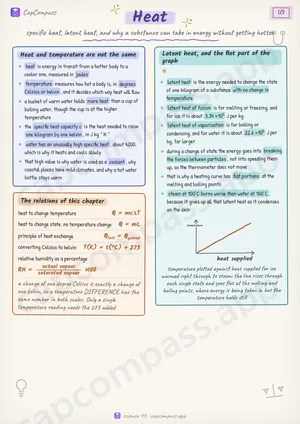
Latent heat, and the flat part of the graph
- latent heat is the energy needed to change the state of one kilogram of a substance with no change in temperature
- latent heat of fusion is for melting or freezing, and for ice it is about 3.34 × 10^5 J per kg
- latent heat of vaporisation is for boiling or condensing, and for water it is about 22.6 × 10^5 J per kg, far larger
- during a change of state the energy goes into breaking the forces between particles, not into speeding them up, so the thermometer does not move
- that is why a heating curve has flat portions at the melting and boiling points
- steam at 100°C burns worse than water at 100°C, because it gives up all that latent heat as it condenses on the skin
Page 1 of 3. The full sheet, all 3 pages, opens free in the app.
What this Heat sheet covers
- Heat and temperature
- Specific heat capacity
- Heat and temperature are not the same
- The relations of this chapter
- heat to change temperature
- heat to change state, no temperature change
- principle of heat exchange
- converting Celsius to kelvin
- relative humidity as a percentage
- Latent heat
- Change of state
- Latent heat, and the flat part of the graph
- Heat across a change of state
- Working a two stage problem
- Humidity
- Relative humidity
- Dew point
- Humidity and dew
- Why water behaves oddly
- Which formula each stage needs
- Symbols in this chapter
- Traps that cost marks
- Tricks that save time
How CapCompass uses this sheet
These notes are not a standalone PDF. CapCompass plans Science chapter by chapter against your real exam dates and free hours, and when the plan reaches Heat the sheet opens inside the study block itself — at the page covering the sub-topic that block is on, with the timer still running. Revision arrives at the moment the plan says revise, instead of having to be gone looking for.
More Science Class 10 revision notes
- Animal Classification
- Carbon Compounds
- Cell Biology and Biotechnology
- Disaster Management
- Effects of Electric Current
- Environmental Management
- Gravitation
- Heredity and Evolution
- Introduction to Microbiology
- Lenses
- Life Processes in Living Organisms Part 1
- Life Processes in Living Organisms Part 2
- Metallurgy
- Periodic Classification of Elements
- Refraction of Light
- Social Health
- Space Missions
- Towards Green Energy