Space Missions — Class 10 Maharashtra SSC Science revision notes
A 4-page visual revision sheet for Space Missions, written for Class 10 Maharashtra SSC Science. Formulas, diagrams and the traps that cost marks, laid out to be read the night before rather than the term before. Free, and it opens inside CapCompass.
 Page 1 as PDF
Space Missions in one look
why a satellite stays up, the orbits worth using, and what launch vehicles have to overcome
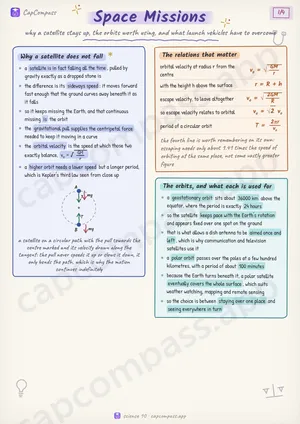
Why a satellite does not fall
- a satellite is in fact falling all the time, pulled by gravity exactly as a dropped stone is
- the difference is its sideways speed: it moves forward fast enough that the ground curves away beneath it as it falls
- so it keeps missing the Earth, and that continuous missing is the orbit
- the gravitational pull supplies the centripetal force needed to keep it moving in a curve
- the orbital velocity is the speed at which those two exactly balance, v_o = √GM/r
- a higher orbit needs a lower speed but a longer period, which is Kepler's third law seen from close up
The relations that matter
- orbital velocity at radius r from the centre
v_o = √GM/r - with the height h above the surface
r = R + h - escape velocity, to leave altogether
v_e = √2GM/R - so escape velocity relates to orbital
v_e = √2 v_o - period of a circular orbit
T = 2π r/v_o
The orbits, and what each is used for
- a geostationary orbit sits about 36000 km above the equator, where the period is exactly 24 hours
- so the satellite keeps pace with the Earth's rotation and appears fixed over one spot on the ground
- that is what allows a dish antenna to be aimed once and left, which is why communication and television satellites use it
- a polar orbit passes over the poles at a few hundred kilometres, with a period of about 100 minutes
- because the Earth turns beneath it, a polar satellite eventually covers the whole surface, which suits weather watching, mapping and remote sensing
- so the choice is between staying over one place and seeing everywhere in turn
Page 1 of 4. The full sheet, all 4 pages, opens free in the app.
What this Space Missions sheet covers
- Artificial satellite
- Orbital velocity
- Why a satellite does not fall
- The relations that matter
- orbital velocity at radius r from the centre
- with the height h above the surface
- escape velocity, to leave altogether
- so escape velocity relates to orbital
- period of a circular orbit
- Geostationary orbit
- Polar orbit
- The orbits, and what each is used for
- The two working orbits
- Geostationary
- Polar
- Launch vehicle
- Multistage rocket
- Launch vehicles
- What satellites are used for
- Indian space milestones
- Space debris
- Terms in this chapter
- Traps that cost marks
- Tricks that save time
How CapCompass uses this sheet
These notes are not a standalone PDF. CapCompass plans Science chapter by chapter against your real exam dates and free hours, and when the plan reaches Space Missions the sheet opens inside the study block itself — at the page covering the sub-topic that block is on, with the timer still running. Revision arrives at the moment the plan says revise, instead of having to be gone looking for.
More Science Class 10 revision notes
- Animal Classification
- Carbon Compounds
- Cell Biology and Biotechnology
- Disaster Management
- Effects of Electric Current
- Environmental Management
- Gravitation
- Heat
- Heredity and Evolution
- Introduction to Microbiology
- Lenses
- Life Processes in Living Organisms Part 1
- Life Processes in Living Organisms Part 2
- Metallurgy
- Periodic Classification of Elements
- Refraction of Light
- Social Health
- Towards Green Energy