Heredity and Evolution — Class 10 Maharashtra SSC Science revision notes
A 4-page visual revision sheet for Heredity and Evolution, written for Class 10 Maharashtra SSC Science. Formulas, diagrams and the traps that cost marks, laid out to be read the night before rather than the term before. Free, and it opens inside CapCompass.
 Page 1 as PDF
Heredity and Evolution in one look
how traits pass down, how sex is decided, and the evidence that species change over time
The vocabulary of inheritance
- heredity is the passing of traits from parents to offspring, and variation is the differences between them
- a gene is a segment of DNA carrying the instruction for a trait, and its alternative forms are alleles
- genotype is the genetic makeup, written with letters, and phenotype is the visible appearance
- homozygous means the two alleles are the same, TT or tt, and heterozygous means they differ, Tt
- a dominant allele shows in the phenotype even when only one copy is present, and a recessive one shows only when both copies are recessive
- so TT and Tt look identical while only tt looks different, which is why a recessive trait can skip a generation
Mendel's laws
- Mendel worked on the garden pea, chosen because it has clear contrasting traits, a short life cycle and self pollinates naturally
- law of dominance: in a pair of contrasting alleles, only the dominant one is expressed in the first generation
- law of segregation: the two alleles of a pair separate during gamete formation, so each gamete carries only one
- law of independent assortment: alleles of different traits are inherited independently of one another
- a monohybrid cross of two heterozygotes gives a phenotype ratio of 3 : 1 and a genotype ratio of 1 : 2 : 1
- a dihybrid cross of two double heterozygotes gives 9 : 3 : 3 : 1
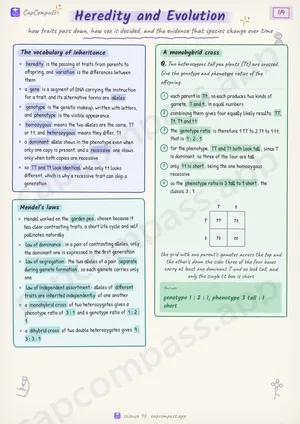
A monohybrid cross
Q. Two heterozygous tall pea plants (Tt) are crossed. Give the genotype and phenotype ratios of the offspring.
- each parent is Tt, so each produces two kinds of gamete, T and t, in equal numbers
- combining them gives four equally likely results: TT, Tt, Tt and tt
- the genotype ratio is therefore 1 TT to 2 Tt to 1 tt, that is 1 : 2 : 1
- for the phenotype, TT and Tt both look tall, since T is dominant, so three of the four are tall
- only tt is short, being the one homozygous recessive
- so the phenotype ratio is 3 tall to 1 short, the classic 3 : 1
Answer: genotype 1 : 2 : 1, phenotype 3 tall : 1 short
Page 1 of 4. The full sheet, all 4 pages, opens free in the app.
What this Heredity and Evolution sheet covers
- Heredity
- Gene and allele
- Genotype and phenotype
- The vocabulary of inheritance
- Mendel's experiments
- Law of dominance
- Law of segregation
- Law of independent assortment
- Mendel's laws
- A monohybrid cross
- Sex determination
- Sex chromosomes
- How sex is determined in humans
- Variation, and where it comes from
- Evolution
- Natural selection
- Speciation
- Evolution and natural selection
- Homologous organs
- Analogous organs
- Fossils
- The evidence for evolution
- Homologous
- Analogous
- Vestigial organs
- Terms that are easily swapped
- Symbols in this chapter
- Traps that cost marks
- Tricks that save time
How CapCompass uses this sheet
These notes are not a standalone PDF. CapCompass plans Science chapter by chapter against your real exam dates and free hours, and when the plan reaches Heredity and Evolution the sheet opens inside the study block itself — at the page covering the sub-topic that block is on, with the timer still running. Revision arrives at the moment the plan says revise, instead of having to be gone looking for.
More Science Class 10 revision notes
- Animal Classification
- Carbon Compounds
- Cell Biology and Biotechnology
- Disaster Management
- Effects of Electric Current
- Environmental Management
- Gravitation
- Heat
- Introduction to Microbiology
- Lenses
- Life Processes in Living Organisms Part 1
- Life Processes in Living Organisms Part 2
- Metallurgy
- Periodic Classification of Elements
- Refraction of Light
- Social Health
- Space Missions
- Towards Green Energy