Lenses — Class 10 Maharashtra SSC Science revision notes
A 4-page visual revision sheet for Lenses, written for Class 10 Maharashtra SSC Science. Formulas, diagrams and the traps that cost marks, laid out to be read the night before rather than the term before. Free, and it opens inside CapCompass.
 Page 1 as PDF
Lenses in one look
converging and diverging, one formula for both, and the sign convention that makes it work
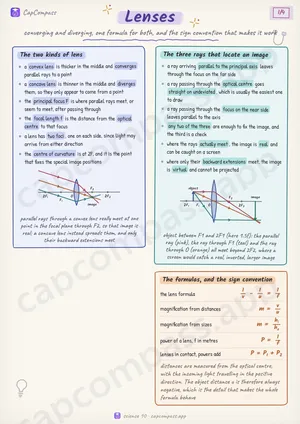
The two kinds of lens
- a convex lens is thicker in the middle and converges parallel rays to a point
- a concave lens is thinner in the middle and diverges them, so they only appear to come from a point
- the principal focus F is where parallel rays meet, or seem to meet, after passing through
- the focal length f is the distance from the optical centre to that focus
- a lens has two foci, one on each side, since light may arrive from either direction
- the centre of curvature is at 2F, and it is the point that fixes the special image positions
The three rays that locate an image
- a ray arriving parallel to the principal axis leaves through the focus on the far side
- a ray passing through the optical centre goes straight on undeviated, which is usually the easiest one to draw
- a ray passing through the focus on the near side leaves parallel to the axis
- any two of the three are enough to fix the image, and the third is a check
- where the rays actually meet, the image is real and can be caught on a screen
- where only their backward extensions meet, the image is virtual and cannot be projected
The formulas, and the sign convention
- the lens formula
1/v - 1/u = 1/f - magnification from distances
m = v/u - magnification from sizes
m = h_i/h_o - power of a lens, f in metres
P = 1/f - lenses in contact, powers add
P = P_1 + P_2
Page 1 of 4. The full sheet, all 4 pages, opens free in the app.
What this Lenses sheet covers
- Convex lens
- Concave lens
- Focal length
- The two kinds of lens
- The three rays that locate an image
- The formulas, and the sign convention
- the lens formula
- magnification from distances
- magnification from sizes
- power of a lens, f in metres
- lenses in contact, powers add
- Sign convention
- The sign convention, stated once
- Images formed by a convex lens
- The table's rows as ray diagrams
- Locating an image
- Reading the answer's signs
- Power of a lens
- Dioptre
- Defects of vision
- Power, and lenses in use
- Symbols in this chapter
- Traps that cost marks
- Tricks that save time
How CapCompass uses this sheet
These notes are not a standalone PDF. CapCompass plans Science chapter by chapter against your real exam dates and free hours, and when the plan reaches Lenses the sheet opens inside the study block itself — at the page covering the sub-topic that block is on, with the timer still running. Revision arrives at the moment the plan says revise, instead of having to be gone looking for.
More Science Class 10 revision notes
- Animal Classification
- Carbon Compounds
- Cell Biology and Biotechnology
- Disaster Management
- Effects of Electric Current
- Environmental Management
- Gravitation
- Heat
- Heredity and Evolution
- Introduction to Microbiology
- Life Processes in Living Organisms Part 1
- Life Processes in Living Organisms Part 2
- Metallurgy
- Periodic Classification of Elements
- Refraction of Light
- Social Health
- Space Missions
- Towards Green Energy