Periodic Classification of Elements — Class 10 Maharashtra SSC Science revision notes
A 3-page visual revision sheet for Periodic Classification of Elements, written for Class 10 Maharashtra SSC Science. Formulas, diagrams and the traps that cost marks, laid out to be read the night before rather than the term before. Free, and it opens inside CapCompass.
 Page 1 as PDF
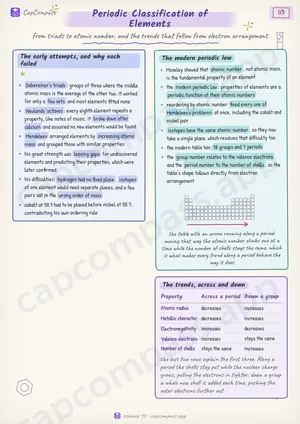
Periodic Classification of Elements in one look
from triads to atomic number, and the trends that follow from electron arrangement
The early attempts, and why each failed
- Dobereiner's triads: groups of three where the middle atomic mass is the average of the other two. It worked for only a few sets and most elements fitted none
- Newlands' octaves: every eighth element repeats a property, like notes of music. It broke down after calcium and assumed no new elements would be found
- Mendeleev arranged elements by increasing atomic mass and grouped those with similar properties
- his great strength was leaving gaps for undiscovered elements and predicting their properties, which were later confirmed
- his difficulties: hydrogen had no fixed place, isotopes of one element would need separate places, and a few pairs sat in the wrong order of mass
- cobalt at 58.9 had to be placed before nickel at 58.7, contradicting his own ordering rule
The modern periodic law
- Moseley showed that atomic number, not atomic mass, is the fundamental property of an element
- the modern periodic law: properties of elements are a periodic function of their atomic numbers
- reordering by atomic number fixed every one of Mendeleev's problems at once, including the cobalt and nickel pair
- isotopes have the same atomic number, so they now take a single place, which resolves that difficulty too
- the modern table has 18 groups and 7 periods
- the group number relates to the valence electrons and the period number to the number of shells, so the table's shape follows directly from electron arrangement
The trends, across and down
| Property | Across a period | Down a group |
|---|---|---|
| Atomic radius | decreases | increases |
| Metallic character | decreases | increases |
| Electronegativity | increases | decreases |
| Valence electrons | increases | stays the same |
| Number of shells | stays the same | increases |
Page 1 of 3. The full sheet, all 3 pages, opens free in the app.
What this Periodic Classification of Elements sheet covers
- Dobereiner's triads
- Newlands' octaves
- Mendeleev's periodic table
- The early attempts, and why each failed
- Modern periodic law
- Atomic number
- The modern periodic law
- The trends, across and down
- Why the size trend runs that way
- Metals, non-metals and the staircase
- Placing an element from its configuration
- Reading the table from a configuration
- The families worth naming
- Terms in this chapter
- Traps that cost marks
- Tricks that save time
How CapCompass uses this sheet
These notes are not a standalone PDF. CapCompass plans Science chapter by chapter against your real exam dates and free hours, and when the plan reaches Periodic Classification of Elements the sheet opens inside the study block itself — at the page covering the sub-topic that block is on, with the timer still running. Revision arrives at the moment the plan says revise, instead of having to be gone looking for.
More Science Class 10 revision notes
- Animal Classification
- Carbon Compounds
- Cell Biology and Biotechnology
- Disaster Management
- Effects of Electric Current
- Environmental Management
- Gravitation
- Heat
- Heredity and Evolution
- Introduction to Microbiology
- Lenses
- Life Processes in Living Organisms Part 1
- Life Processes in Living Organisms Part 2
- Metallurgy
- Refraction of Light
- Social Health
- Space Missions
- Towards Green Energy