Current Electricity — Class 9 Maharashtra SSC Science revision notes
A 4-page visual revision sheet for Current Electricity, written for Class 9 Maharashtra SSC Science. Formulas, diagrams and the traps that cost marks, laid out to be read the night before rather than the term before. Free, and it opens inside CapCompass.
 Page 1 as PDF
Current Electricity in one look
charge in motion, the law relating it to voltage, and how resistors combine
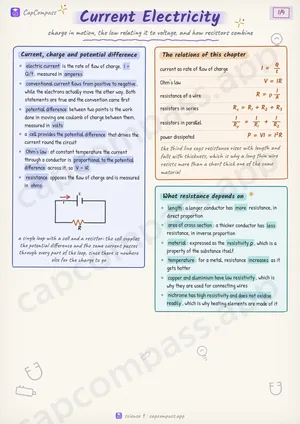
Current, charge and potential difference
- electric current is the rate of flow of charge, I = Q/t, measured in amperes
- conventional current flows from positive to negative, while the electrons actually move the other way. Both statements are true and the convention came first
- potential difference between two points is the work done in moving one coulomb of charge between them, measured in volts
- a cell provides the potential difference that drives the current round the circuit
- Ohm's law: at constant temperature the current through a conductor is proportional to the potential difference across it, so V = IR
- resistance opposes the flow of charge and is measured in ohms
The relations of this chapter
- current as rate of flow of charge
I = Q/t - Ohm's law
V = IR - resistance of a wire
R = rhol/A - resistors in series
R_s = R_1 + R_2 + R_3 - resistors in parallel
1/R_p = 1/R_1 + 1/R_2 - power dissipated
P = VI = I^2R
What resistance depends on
- length: a longer conductor has more resistance, in direct proportion
- area of cross section: a thicker conductor has less resistance, in inverse proportion
- material: expressed as the resistivity ρ, which is a property of the substance itself
- temperature: for a metal, resistance increases as it gets hotter
- copper and aluminium have low resistivity, which is why they are used for connecting wires
- nichrome has high resistivity and does not oxidise readily, which is why heating elements are made of it
Page 1 of 4. The full sheet, all 4 pages, opens free in the app.
What this Current Electricity sheet covers
- Electric current
- Potential difference
- Ohm's law
- Current, charge and potential difference
- The relations of this chapter
- current as rate of flow of charge
- resistance of a wire
- resistors in series
- resistors in parallel
- power dissipated
- What resistance depends on
- Series against parallel
- Series
- Parallel
- A combination of resistors
- Reading and drawing a circuit
- Conductors, insulators and heating
- Symbols in this chapter
- Traps that cost marks
- Tricks that save time
How CapCompass uses this sheet
These notes are not a standalone PDF. CapCompass plans Science chapter by chapter against your real exam dates and free hours, and when the plan reaches Current Electricity the sheet opens inside the study block itself — at the page covering the sub-topic that block is on, with the timer still running. Revision arrives at the moment the plan says revise, instead of having to be gone looking for.
More Science Class 9 revision notes
- Acids, Bases and Salts
- Carbon : An Important Element
- Classification of Plants
- Energy Flow in an Ecosystem
- Environmental Management
- Heredity and Variation
- Information Communication Technology (ICT)
- Introduction to Biotechnology
- Laws of Motion
- Life Processes in Living Organisms
- Measurement of Matter
- Observing Space : Telescopes
- Reflection of Light
- Study of Sound
- Substances in Common Use
- Useful and Harmful Microbes
- Work and Energy