Environmental Management — Class 9 Maharashtra SSC Science revision notes
A 3-page visual revision sheet for Environmental Management, written for Class 9 Maharashtra SSC Science. Formulas, diagrams and the traps that cost marks, laid out to be read the night before rather than the term before. Free, and it opens inside CapCompass.
 Page 1 as PDF
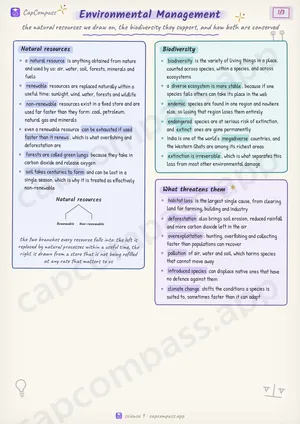
Environmental Management in one look
the natural resources we draw on, the biodiversity they support, and how both are conserved
Natural resources
- a natural resource is anything obtained from nature and used by us: air, water, soil, forests, minerals and fuels
- renewable resources are replaced naturally within a useful time: sunlight, wind, water, forests and wildlife
- non-renewable resources exist in a fixed store and are used far faster than they form: coal, petroleum, natural gas and minerals
- even a renewable resource can be exhausted if used faster than it renews, which is what overfishing and deforestation are
- forests are called green lungs because they take in carbon dioxide and release oxygen
- soil takes centuries to form and can be lost in a single season, which is why it is treated as effectively non-renewable
Biodiversity
- biodiversity is the variety of living things in a place, counted across species, within a species, and across ecosystems
- a diverse ecosystem is more stable, because if one species fails others can take its place in the web
- endemic species are found in one region and nowhere else, so losing that region loses them entirely
- endangered species are at serious risk of extinction, and extinct ones are gone permanently
- India is one of the world's megadiverse countries, and the Western Ghats are among its richest areas
- extinction is irreversible, which is what separates this loss from most other environmental damage
What threatens them
- habitat loss is the largest single cause, from clearing land for farming, building and industry
- deforestation also brings soil erosion, reduced rainfall and more carbon dioxide left in the air
- overexploitation: hunting, overfishing and collecting faster than populations can recover
- pollution of air, water and soil, which harms species that cannot move away
- introduced species can displace native ones that have no defence against them
- climate change shifts the conditions a species is suited to, sometimes faster than it can adapt
Page 1 of 3. The full sheet, all 3 pages, opens free in the app.
What this Environmental Management sheet covers
- Natural resources
- Renewable and non-renewable
- Biodiversity
- Endangered species
- Endemic species
- What threatens them
- Conservation
- National park
- Sanctuary
- How conservation is done
- Managing water and soil
- The three kinds of protected area
- Terms in this chapter
- Traps that cost marks
- Tricks that save time
How CapCompass uses this sheet
These notes are not a standalone PDF. CapCompass plans Science chapter by chapter against your real exam dates and free hours, and when the plan reaches Environmental Management the sheet opens inside the study block itself — at the page covering the sub-topic that block is on, with the timer still running. Revision arrives at the moment the plan says revise, instead of having to be gone looking for.
More Science Class 9 revision notes
- Acids, Bases and Salts
- Carbon : An Important Element
- Classification of Plants
- Current Electricity
- Energy Flow in an Ecosystem
- Heredity and Variation
- Information Communication Technology (ICT)
- Introduction to Biotechnology
- Laws of Motion
- Life Processes in Living Organisms
- Measurement of Matter
- Observing Space : Telescopes
- Reflection of Light
- Study of Sound
- Substances in Common Use
- Useful and Harmful Microbes
- Work and Energy