Observing Space : Telescopes — Class 9 Maharashtra SSC Science revision notes
A 3-page visual revision sheet for Observing Space : Telescopes, written for Class 9 Maharashtra SSC Science. Formulas, diagrams and the traps that cost marks, laid out to be read the night before rather than the term before. Free, and it opens inside CapCompass.
 Page 1 as PDF
Observing Space : Telescopes in one look
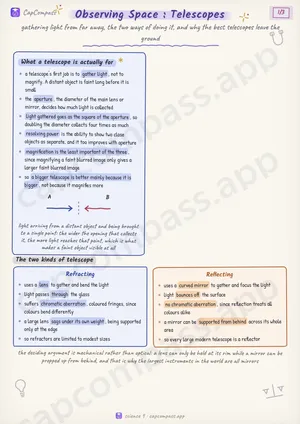
gathering light from far away, the two ways of doing it, and why the best telescopes leave the ground
What a telescope is actually for
- a telescope's first job is to gather light, not to magnify. A distant object is faint long before it is small
- the aperture, the diameter of the main lens or mirror, decides how much light is collected
- light gathered goes as the square of the aperture, so doubling the diameter collects four times as much
- resolving power is the ability to show two close objects as separate, and it too improves with aperture
- magnification is the least important of the three, since magnifying a faint blurred image only gives a larger faint blurred image
- so a bigger telescope is better mainly because it is bigger, not because it magnifies more
The two kinds of telescope
- uses a lens to gather and bend the light
- light passes through the glass
- suffers chromatic aberration, coloured fringes, since colours bend differently
- a large lens sags under its own weight, being supported only at the edge
- so refractors are limited to modest sizes
- uses a curved mirror to gather and focus the light
- light bounces off the surface
- no chromatic aberration, since reflection treats all colours alike
- a mirror can be supported from behind across its whole area
- so every large modern telescope is a reflector
Page 1 of 3. The full sheet, all 3 pages, opens free in the app.
What this Observing Space : Telescopes sheet covers
- Telescope
- Aperture
- Resolving power
- What a telescope is actually for
- The two kinds of telescope
- Refracting
- Reflecting
- Why the atmosphere is a problem
- Radio telescope
- Space telescope
- Beyond visible light
- Indian astronomy
- Choosing where to observe from
- Terms in this chapter
- Traps that cost marks
- Tricks that save time
How CapCompass uses this sheet
These notes are not a standalone PDF. CapCompass plans Science chapter by chapter against your real exam dates and free hours, and when the plan reaches Observing Space : Telescopes the sheet opens inside the study block itself — at the page covering the sub-topic that block is on, with the timer still running. Revision arrives at the moment the plan says revise, instead of having to be gone looking for.
More Science Class 9 revision notes
- Acids, Bases and Salts
- Carbon : An Important Element
- Classification of Plants
- Current Electricity
- Energy Flow in an Ecosystem
- Environmental Management
- Heredity and Variation
- Information Communication Technology (ICT)
- Introduction to Biotechnology
- Laws of Motion
- Life Processes in Living Organisms
- Measurement of Matter
- Reflection of Light
- Study of Sound
- Substances in Common Use
- Useful and Harmful Microbes
- Work and Energy