Measurement of Matter — Class 9 Maharashtra SSC Science revision notes
A 3-page visual revision sheet for Measurement of Matter, written for Class 9 Maharashtra SSC Science. Formulas, diagrams and the traps that cost marks, laid out to be read the night before rather than the term before. Free, and it opens inside CapCompass.
 Page 1 as PDF
Measurement of Matter in one look
counting atoms by weighing them, and the mole that makes the counting possible
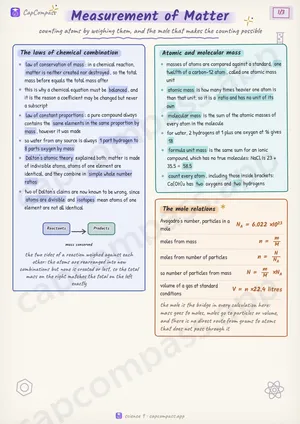
The laws of chemical combination
- law of conservation of mass: in a chemical reaction, matter is neither created nor destroyed, so the total mass before equals the total mass after
- this is why a chemical equation must be balanced, and it is the reason a coefficient may be changed but never a subscript
- law of constant proportions: a pure compound always contains the same elements in the same proportion by mass, however it was made
- so water from any source is always 1 part hydrogen to 8 parts oxygen by mass
- Dalton's atomic theory explained both: matter is made of indivisible atoms, atoms of one element are identical, and they combine in simple whole number ratios
- two of Dalton's claims are now known to be wrong, since atoms are divisible and isotopes mean atoms of one element are not all identical
Atomic and molecular mass
- masses of atoms are compared against a standard, one twelfth of a carbon-12 atom, called one atomic mass unit
- atomic mass is how many times heavier one atom is than that unit, so it is a ratio and has no unit of its own
- molecular mass is the sum of the atomic masses of every atom in the molecule
- for water, 2 hydrogens at 1 plus one oxygen at 16 gives 18
- formula unit mass is the same sum for an ionic compound, which has no true molecules: NaCl is 23 + 35.5 = 58.5
- count every atom, including those inside brackets: Ca(OH)₂ has two oxygens and two hydrogens
The mole relations
- Avogadro's number, particles in a mole
N_A = 6.022 × 10^23 - moles from mass
n = m/M - moles from number of particles
n = N/N_A - so number of particles from mass
N = m/M × N_A - volume of a gas at standard conditions
V = n × 22.4 litres
Page 1 of 3. The full sheet, all 3 pages, opens free in the app.
What this Measurement of Matter sheet covers
- Law of conservation of mass
- Law of constant proportions
- The laws of chemical combination
- Atomic mass
- Molecular mass
- Formula unit mass
- Atomic and molecular mass
- The mole relations
- Avogadro's number, particles in a mole
- moles from mass
- moles from number of particles
- so number of particles from mass
- volume of a gas at standard conditions
- Mole concept
- Avogadro's number
- Molar mass
- What a mole is
- From mass to number of molecules
- Working a mole problem
- One mole of some familiar substances
- Symbols in this chapter
- Traps that cost marks
- Tricks that save time
How CapCompass uses this sheet
These notes are not a standalone PDF. CapCompass plans Science chapter by chapter against your real exam dates and free hours, and when the plan reaches Measurement of Matter the sheet opens inside the study block itself — at the page covering the sub-topic that block is on, with the timer still running. Revision arrives at the moment the plan says revise, instead of having to be gone looking for.
More Science Class 9 revision notes
- Acids, Bases and Salts
- Carbon : An Important Element
- Classification of Plants
- Current Electricity
- Energy Flow in an Ecosystem
- Environmental Management
- Heredity and Variation
- Information Communication Technology (ICT)
- Introduction to Biotechnology
- Laws of Motion
- Life Processes in Living Organisms
- Observing Space : Telescopes
- Reflection of Light
- Study of Sound
- Substances in Common Use
- Useful and Harmful Microbes
- Work and Energy