Study of Sound — Class 9 Maharashtra SSC Science revision notes
A 3-page visual revision sheet for Study of Sound, written for Class 9 Maharashtra SSC Science. Formulas, diagrams and the traps that cost marks, laid out to be read the night before rather than the term before. Free, and it opens inside CapCompass.
 Page 1 as PDF
Study of Sound in one look
a wave that needs a medium, the quantities that describe it, and the echo it can produce
How sound travels
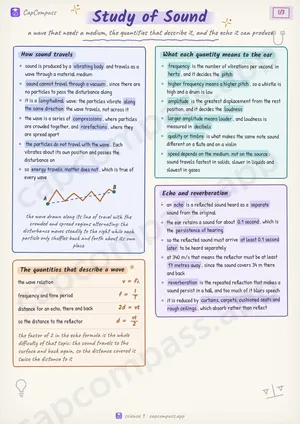
- sound is produced by a vibrating body and travels as a wave through a material medium
- sound cannot travel through a vacuum, since there are no particles to pass the disturbance along
- it is a longitudinal wave: the particles vibrate along the same direction the wave travels, not across it
- the wave is a series of compressions, where particles are crowded together, and rarefactions, where they are spread apart
- the particles do not travel with the wave. Each vibrates about its own position and passes the disturbance on
- so energy travels, matter does not, which is true of every wave
The quantities that describe a wave
- the wave relation
v = fλ - frequency and time period
f = 1/T - distance for an echo, there and back
2d = vt - so the distance to the reflector
d = vt/2
What each quantity means to the ear
- frequency is the number of vibrations per second, in hertz, and it decides the pitch
- higher frequency means a higher pitch, so a whistle is high and a drum is low
- amplitude is the greatest displacement from the rest position, and it decides the loudness
- larger amplitude means louder, and loudness is measured in decibels
- quality or timbre is what makes the same note sound different on a flute and on a violin
- speed depends on the medium, not on the source: sound travels fastest in solids, slower in liquids and slowest in gases
Echo and reverberation
- an echo is a reflected sound heard as a separate sound from the original
- the ear retains a sound for about 0.1 second, which is the persistence of hearing
- so the reflected sound must arrive at least 0.1 second later to be heard separately
- at 340 m/s that means the reflector must be at least 17 metres away, since the sound covers 34 m there and back
- reverberation is the repeated reflection that makes a sound persist in a hall, and too much of it blurs speech
- it is reduced by curtains, carpets, cushioned seats and rough ceilings, which absorb rather than reflect
Page 1 of 3. The full sheet, all 3 pages, opens free in the app.
What this Study of Sound sheet covers
- Sound wave
- Longitudinal wave
- Compression and rarefaction
- How sound travels
- The quantities that describe a wave
- the wave relation
- frequency and time period
- distance for an echo, there and back
- so the distance to the reflector
- Pitch
- Loudness
- Quality
- What each quantity means to the ear
- Echo
- Reverberation
- Persistence of hearing
- Echo and reverberation
- An echo calculation
- Audible range
- Ultrasound
- Infrasound
- The range of hearing, and beyond it
- Speed of sound in different media
- Symbols in this chapter
- Traps that cost marks
- Tricks that save time
How CapCompass uses this sheet
These notes are not a standalone PDF. CapCompass plans Science chapter by chapter against your real exam dates and free hours, and when the plan reaches Study of Sound the sheet opens inside the study block itself — at the page covering the sub-topic that block is on, with the timer still running. Revision arrives at the moment the plan says revise, instead of having to be gone looking for.
More Science Class 9 revision notes
- Acids, Bases and Salts
- Carbon : An Important Element
- Classification of Plants
- Current Electricity
- Energy Flow in an Ecosystem
- Environmental Management
- Heredity and Variation
- Information Communication Technology (ICT)
- Introduction to Biotechnology
- Laws of Motion
- Life Processes in Living Organisms
- Measurement of Matter
- Observing Space : Telescopes
- Reflection of Light
- Substances in Common Use
- Useful and Harmful Microbes
- Work and Energy