Introduction to Biotechnology — Class 9 Maharashtra SSC Science revision notes
A 3-page visual revision sheet for Introduction to Biotechnology, written for Class 9 Maharashtra SSC Science. Formulas, diagrams and the traps that cost marks, laid out to be read the night before rather than the term before. Free, and it opens inside CapCompass.
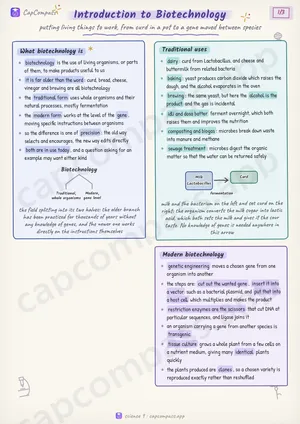 Page 1 as PDF
Introduction to Biotechnology in one look
putting living things to work, from curd in a pot to a gene moved between species
What biotechnology is
- biotechnology is the use of living organisms, or parts of them, to make products useful to us
- it is far older than the word: curd, bread, cheese, vinegar and brewing are all biotechnology
- the traditional form uses whole organisms and their natural processes, mostly fermentation
- the modern form works at the level of the gene, moving specific instructions between organisms
- so the difference is one of precision: the old way selects and encourages, the new way edits directly
- both are in use today, and a question asking for an example may want either kind
Traditional uses
- dairy: curd from Lactobacillus, and cheese and buttermilk from related bacteria
- baking: yeast produces carbon dioxide which raises the dough, and the alcohol evaporates in the oven
- brewing: the same yeast, but here the alcohol is the product and the gas is incidental
- idli and dosa batter ferment overnight, which both raises them and improves the nutrition
- composting and biogas: microbes break down waste into manure and methane
- sewage treatment: microbes digest the organic matter so that the water can be returned safely
Modern biotechnology
- genetic engineering moves a chosen gene from one organism into another
- the steps are: cut out the wanted gene, insert it into a vector such as a bacterial plasmid, and put that into a host cell which multiplies and makes the product
- restriction enzymes are the scissors that cut DNA at particular sequences, and ligase joins it
- an organism carrying a gene from another species is transgenic
- tissue culture grows a whole plant from a few cells on a nutrient medium, giving many identical plants quickly
- the plants produced are clones, so a chosen variety is reproduced exactly rather than reshuffled
Page 1 of 3. The full sheet, all 3 pages, opens free in the app.
What this Introduction to Biotechnology sheet covers
- Biotechnology
- Traditional biotechnology
- What biotechnology is
- Traditional uses
- Genetic engineering
- Transgenic organism
- Tissue culture
- Modern biotechnology
- Where it is applied
- The advantages and the concerns
- Traditional against modern
- Terms in this chapter
- Traps that cost marks
- Tricks that save time
How CapCompass uses this sheet
These notes are not a standalone PDF. CapCompass plans Science chapter by chapter against your real exam dates and free hours, and when the plan reaches Introduction to Biotechnology the sheet opens inside the study block itself — at the page covering the sub-topic that block is on, with the timer still running. Revision arrives at the moment the plan says revise, instead of having to be gone looking for.
More Science Class 9 revision notes
- Acids, Bases and Salts
- Carbon : An Important Element
- Classification of Plants
- Current Electricity
- Energy Flow in an Ecosystem
- Environmental Management
- Heredity and Variation
- Information Communication Technology (ICT)
- Laws of Motion
- Life Processes in Living Organisms
- Measurement of Matter
- Observing Space : Telescopes
- Reflection of Light
- Study of Sound
- Substances in Common Use
- Useful and Harmful Microbes
- Work and Energy