Reflection of Light — Class 9 Maharashtra SSC Science revision notes
A 3-page visual revision sheet for Reflection of Light, written for Class 9 Maharashtra SSC Science. Formulas, diagrams and the traps that cost marks, laid out to be read the night before rather than the term before. Free, and it opens inside CapCompass.
 Page 1 as PDF
Reflection of Light in one look
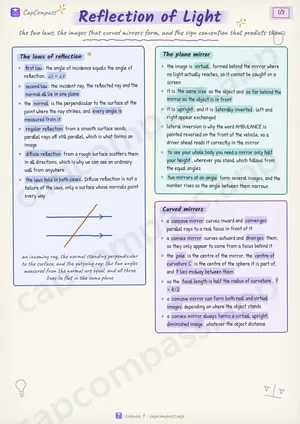
the two laws, the images that curved mirrors form, and the sign convention that predicts them
The laws of reflection
- first law: the angle of incidence equals the angle of reflection, ∠i = ∠r
- second law: the incident ray, the reflected ray and the normal all lie in one plane
- the normal is the perpendicular to the surface at the point where the ray strikes, and every angle is measured from it
- regular reflection from a smooth surface sends parallel rays off still parallel, which is what forms an image
- diffuse reflection from a rough surface scatters them in all directions, which is why we can see an ordinary wall from anywhere
- the laws hold in both cases. Diffuse reflection is not a failure of the laws, only a surface whose normals point every way
The plane mirror
- the image is virtual, formed behind the mirror where no light actually reaches, so it cannot be caught on a screen
- it is the same size as the object and as far behind the mirror as the object is in front
- it is upright, and it is laterally inverted: left and right appear exchanged
- lateral inversion is why the word AMBULANCE is painted reversed on the front of the vehicle, so a driver ahead reads it correctly in the mirror
- to see your whole body you need a mirror only half your height, wherever you stand, which follows from the equal angles
- two mirrors at an angle form several images, and the number rises as the angle between them narrows
Curved mirrors
- a concave mirror curves inward and converges parallel rays to a real focus in front of it
- a convex mirror curves outward and diverges them, so they only appear to come from a focus behind it
- the pole is the centre of the mirror, the centre of curvature C is the centre of the sphere it is part of, and F lies midway between them
- so the focal length is half the radius of curvature, f = R/2
- a concave mirror can form both real and virtual images depending on where the object stands
- a convex mirror always forms a virtual, upright, diminished image, whatever the object distance
Page 1 of 3. The full sheet, all 3 pages, opens free in the app.
What this Reflection of Light sheet covers
- Laws of reflection
- Angle of incidence
- The laws of reflection
- The plane mirror
- Concave mirror
- Convex mirror
- Focal length
- Curved mirrors
- The formulas and the sign convention
- the mirror formula
- focal length from radius of curvature
- magnification from distances
- magnification from heights
- The sign convention
- Images in a concave mirror
- Using the mirror formula
- Where curved mirrors are used
- Symbols in this chapter
- Traps that cost marks
- Tricks that save time
How CapCompass uses this sheet
These notes are not a standalone PDF. CapCompass plans Science chapter by chapter against your real exam dates and free hours, and when the plan reaches Reflection of Light the sheet opens inside the study block itself — at the page covering the sub-topic that block is on, with the timer still running. Revision arrives at the moment the plan says revise, instead of having to be gone looking for.
More Science Class 9 revision notes
- Acids, Bases and Salts
- Carbon : An Important Element
- Classification of Plants
- Current Electricity
- Energy Flow in an Ecosystem
- Environmental Management
- Heredity and Variation
- Information Communication Technology (ICT)
- Introduction to Biotechnology
- Laws of Motion
- Life Processes in Living Organisms
- Measurement of Matter
- Observing Space : Telescopes
- Study of Sound
- Substances in Common Use
- Useful and Harmful Microbes
- Work and Energy