Substances in Common Use — Class 9 Maharashtra SSC Science revision notes
A 3-page visual revision sheet for Substances in Common Use, written for Class 9 Maharashtra SSC Science. Formulas, diagrams and the traps that cost marks, laid out to be read the night before rather than the term before. Free, and it opens inside CapCompass.
 Page 1 as PDF
Substances in Common Use in one look
the chemistry behind cleaning, building and preserving the things around us
Soaps and detergents
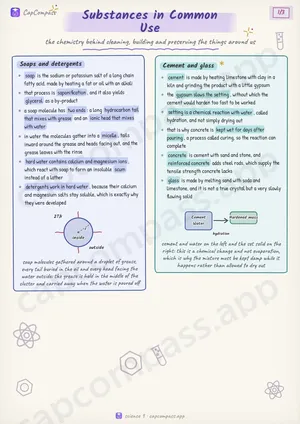
- soap is the sodium or potassium salt of a long chain fatty acid, made by heating a fat or oil with an alkali
- that process is saponification, and it also yields glycerol as a by-product
- a soap molecule has two ends: a long hydrocarbon tail that mixes with grease and an ionic head that mixes with water
- in water the molecules gather into a micelle, tails inward around the grease and heads facing out, and the grease leaves with the rinse
- hard water contains calcium and magnesium ions, which react with soap to form an insoluble scum instead of a lather
- detergents work in hard water, because their calcium and magnesium salts stay soluble, which is exactly why they were developed
Cement and glass
- cement is made by heating limestone with clay in a kiln and grinding the product with a little gypsum
- the gypsum slows the setting, without which the cement would harden too fast to be worked
- setting is a chemical reaction with water, called hydration, and not simply drying out
- that is why concrete is kept wet for days after pouring, a process called curing, so the reaction can complete
- concrete is cement with sand and stone, and reinforced concrete adds steel rods, which supply the tensile strength concrete lacks
- glass is made by melting sand with soda and limestone, and it is not a true crystal but a very slowly flowing solid
Page 1 of 3. The full sheet, all 3 pages, opens free in the app.
What this Substances in Common Use sheet covers
- Soap
- Detergent
- Hard water
- Soaps and detergents
- Cement
- Concrete
- Glass
- Cement and glass
- Food preservation
- Preservative
- Preserving food
- How each method works
- Natural and synthetic fibre
- Plastic
- Thermoplastic
- Fibres and plastics
- The problem with plastics
- Terms in this chapter
- Traps that cost marks
- Tricks that save time
How CapCompass uses this sheet
These notes are not a standalone PDF. CapCompass plans Science chapter by chapter against your real exam dates and free hours, and when the plan reaches Substances in Common Use the sheet opens inside the study block itself — at the page covering the sub-topic that block is on, with the timer still running. Revision arrives at the moment the plan says revise, instead of having to be gone looking for.
More Science Class 9 revision notes
- Acids, Bases and Salts
- Carbon : An Important Element
- Classification of Plants
- Current Electricity
- Energy Flow in an Ecosystem
- Environmental Management
- Heredity and Variation
- Information Communication Technology (ICT)
- Introduction to Biotechnology
- Laws of Motion
- Life Processes in Living Organisms
- Measurement of Matter
- Observing Space : Telescopes
- Reflection of Light
- Study of Sound
- Useful and Harmful Microbes
- Work and Energy