Laws of Motion — Class 9 Maharashtra SSC Science revision notes
A 3-page visual revision sheet for Laws of Motion, written for Class 9 Maharashtra SSC Science. Formulas, diagrams and the traps that cost marks, laid out to be read the night before rather than the term before. Free, and it opens inside CapCompass.
 Page 1 as PDF
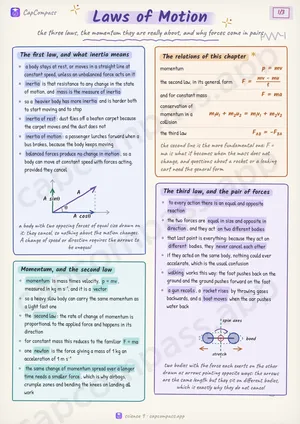
Laws of Motion in one look
the three laws, the momentum they are really about, and why forces come in pairs
The first law, and what inertia means
- a body stays at rest, or moves in a straight line at constant speed, unless an unbalanced force acts on it
- inertia is that resistance to any change in the state of motion, and mass is the measure of inertia
- so a heavier body has more inertia and is harder both to start moving and to stop
- inertia of rest: dust flies off a beaten carpet because the carpet moves and the dust does not
- inertia of motion: a passenger lurches forward when a bus brakes, because the body keeps moving
- balanced forces produce no change in motion, so a body can move at constant speed with forces acting, provided they cancel
Momentum, and the second law
- momentum is mass times velocity, p = mv, measured in kg m s⁻¹, and it is a vector
- so a heavy slow body can carry the same momentum as a light fast one
- the second law: the rate of change of momentum is proportional to the applied force and happens in its direction
- for constant mass this reduces to the familiar F = ma
- one newton is the force giving a mass of 1 kg an acceleration of 1 m s⁻²
- the same change of momentum spread over a longer time needs a smaller force, which is why airbags, crumple zones and bending the knees on landing all work
The relations of this chapter
- momentum
p = mv - the second law, in its general form
F = mv - mu/t - and for constant mass
F = ma - conservation of momentum in a collision
m_1u_1 + m_2u_2 = m_1v_1 + m_2v_2 - the third law
F_AB = -F_BA
The third law, and the pair of forces
- to every action there is an equal and opposite reaction
- the two forces are equal in size and opposite in direction, and they act on two different bodies
- that last point is everything: because they act on different bodies, they never cancel each other
- if they acted on the same body, nothing could ever accelerate, which is the usual confusion
- walking works this way: the foot pushes back on the ground and the ground pushes forward on the foot
- a gun recoils, a rocket rises by throwing gases backwards, and a boat moves when the oar pushes water back
Page 1 of 3. The full sheet, all 3 pages, opens free in the app.
What this Laws of Motion sheet covers
- Newton's first law
- Inertia
- The first law, and what inertia means
- Momentum
- Newton's second law
- Momentum, and the second law
- The relations of this chapter
- the second law, in its general form
- and for constant mass
- conservation of momentum in a collision
- the third law
- Newton's third law
- Action and reaction
- The third law, and the pair of forces
- Conservation of momentum
- Everyday consequences
- Symbols in this chapter
- Traps that cost marks
- Tricks that save time
How CapCompass uses this sheet
These notes are not a standalone PDF. CapCompass plans Science chapter by chapter against your real exam dates and free hours, and when the plan reaches Laws of Motion the sheet opens inside the study block itself — at the page covering the sub-topic that block is on, with the timer still running. Revision arrives at the moment the plan says revise, instead of having to be gone looking for.
More Science Class 9 revision notes
- Acids, Bases and Salts
- Carbon : An Important Element
- Classification of Plants
- Current Electricity
- Energy Flow in an Ecosystem
- Environmental Management
- Heredity and Variation
- Information Communication Technology (ICT)
- Introduction to Biotechnology
- Life Processes in Living Organisms
- Measurement of Matter
- Observing Space : Telescopes
- Reflection of Light
- Study of Sound
- Substances in Common Use
- Useful and Harmful Microbes
- Work and Energy