Useful and Harmful Microbes — Class 9 Maharashtra SSC Science revision notes
A 3-page visual revision sheet for Useful and Harmful Microbes, written for Class 9 Maharashtra SSC Science. Formulas, diagrams and the traps that cost marks, laid out to be read the night before rather than the term before. Free, and it opens inside CapCompass.
 Page 1 as PDF
Useful and Harmful Microbes in one look
the same invisible organisms making our food and causing our diseases
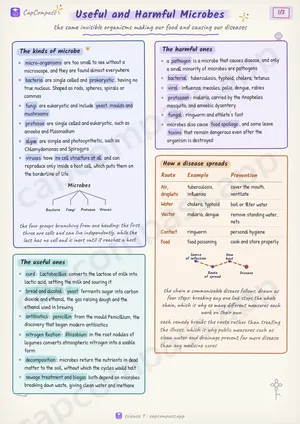
The kinds of microbe
- micro-organisms are too small to see without a microscope, and they are found almost everywhere
- bacteria are single celled and prokaryotic, having no true nucleus. Shaped as rods, spheres, spirals or commas
- fungi are eukaryotic and include yeast, moulds and mushrooms
- protozoa are single celled and eukaryotic, such as amoeba and Plasmodium
- algae are simple and photosynthetic, such as Chlamydomonas and Spirogyra
- viruses have no cell structure at all and can reproduce only inside a host cell, which puts them on the borderline of life
The useful ones
- curd: Lactobacillus converts the lactose of milk into lactic acid, setting the milk and souring it
- bread and alcohol: yeast ferments sugar into carbon dioxide and ethanol, the gas raising dough and the ethanol used in brewing
- antibiotics: penicillin from the mould Penicillium, the discovery that began modern antibiotics
- nitrogen fixation: Rhizobium in the root nodules of legumes converts atmospheric nitrogen into a usable form
- decomposition: microbes return the nutrients in dead matter to the soil, without which the cycles would halt
- sewage treatment and biogas both depend on microbes breaking down waste, giving clean water and methane
The harmful ones
- a pathogen is a microbe that causes disease, and only a small minority of microbes are pathogens
- bacterial: tuberculosis, typhoid, cholera, tetanus
- viral: influenza, measles, polio, dengue, rabies
- protozoan: malaria, carried by the Anopheles mosquito, and amoebic dysentery
- fungal: ringworm and athlete's foot
- microbes also cause food spoilage, and some leave toxins that remain dangerous even after the organism is destroyed
How a disease spreads
| Route | Example | Prevention |
|---|---|---|
| Air, droplets | tuberculosis, influenza | cover the mouth, ventilate |
| Water | cholera, typhoid | boil or filter water |
| Vector | malaria, dengue | remove standing water, nets |
| Contact | ringworm | personal hygiene |
| Food | food poisoning | cook and store properly |
Page 1 of 3. The full sheet, all 3 pages, opens free in the app.
What this Useful and Harmful Microbes sheet covers
- Micro-organism
- Bacteria
- Virus
- The kinds of microbe
- Useful micro-organisms
- Fermentation
- Nitrogen fixation
- The useful ones
- Pathogen
- Communicable disease
- Food spoilage
- The harmful ones
- How a disease spreads
- Prevention and control
- Microbes and food
- Terms in this chapter
- Traps that cost marks
- Tricks that save time
How CapCompass uses this sheet
These notes are not a standalone PDF. CapCompass plans Science chapter by chapter against your real exam dates and free hours, and when the plan reaches Useful and Harmful Microbes the sheet opens inside the study block itself — at the page covering the sub-topic that block is on, with the timer still running. Revision arrives at the moment the plan says revise, instead of having to be gone looking for.
More Science Class 9 revision notes
- Acids, Bases and Salts
- Carbon : An Important Element
- Classification of Plants
- Current Electricity
- Energy Flow in an Ecosystem
- Environmental Management
- Heredity and Variation
- Information Communication Technology (ICT)
- Introduction to Biotechnology
- Laws of Motion
- Life Processes in Living Organisms
- Measurement of Matter
- Observing Space : Telescopes
- Reflection of Light
- Study of Sound
- Substances in Common Use
- Work and Energy