Gravitation — Class 11 Maharashtra HSC Physics revision notes
A 6-page visual revision sheet for Gravitation, written for Class 11 Maharashtra HSC Physics. Formulas, diagrams and the traps that cost marks, laid out to be read the night before rather than the term before. Free, and it opens inside CapCompass.
 Page 1 as PDF
Gravitation in one look
one inverse-square law, from Kepler's ellipses to why an astronaut floats
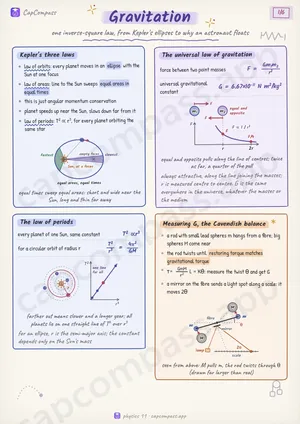
Kepler's three laws
- law of orbits: every planet moves in an ellipse with the Sun at one focus
- law of areas: line to the Sun sweeps equal areas in equal times
- this is just angular momentum conservation
- planet speeds up near the Sun, slows down far from it
- law of periods: T^2 ∝ r^3, for every planet orbiting the same star
The law of periods
- every planet of one Sun, same constant
T^2 ∝ r^3 - for a circular orbit of radius r
T^2/r^3 = 4π^2/GM
The universal law of gravitation
- force between two point masses
F = Gm_1m_2/r^2 - universal gravitational constant
G = 6.67×10^-11 N m^2/kg^2
Measuring G, the Cavendish balance
- a rod with small lead spheres m hangs from a fibre; big spheres M come near
- the rod twists until restoring torque matches gravitational torque
- τ = GmM/r^2L = Kθ: measure the twist θ and get G
- a mirror on the fibre sends a light spot along a scale: it moves 2θ
Page 1 of 6. The full sheet, all 6 pages, opens free in the app.
What this Gravitation sheet covers
- Kepler's three laws
- The law of periods
- every planet of one Sun, same constant
- for a circular orbit of radius r
- The universal law of gravitation
- force between two point masses
- universal gravitational constant
- Measuring G, the Cavendish balance
- Acceleration due to gravity
- at the surface
- at height h above the surface, h ll R
- at depth d below the surface
- g with height or g with depth
- Rotational effect on g: latitude
- g with the shape of the Earth
- Gravitational potential energy
- of a mass m at distance r from mass M
- at infinite separation, by convention
- a small climb h near the surface
- Gravitational potential
- Escape velocity, from energy conservation
- Escape and orbital speed
- escape velocity
- for Earth, numerically
- orbital (critical) velocity at radius r
- Launching a satellite needs two stages
- Time period of a satellite
- circular orbit, radius r = R+h
- in terms of g at that height
- minimum period, close to the surface, r ≈ R
- Energy of an orbiting satellite
- Weightlessness, the lift argument
- Free fall and orbit are the same case
- cable cut, downward acceleration equals g
- orbiting satellite, centripetal acceleration equals g at that height
- Geostationary vs polar satellites
- Symbols
- Beyond Newton: gravity as curved space-time
- Traps that cost marks
- Tricks that save time
How CapCompass uses this sheet
These notes are not a standalone PDF. CapCompass plans Physics chapter by chapter against your real exam dates and free hours, and when the plan reaches Gravitation the sheet opens inside the study block itself — at the page covering the sub-topic that block is on, with the timer still running. Revision arrives at the moment the plan says revise, instead of having to be gone looking for.